
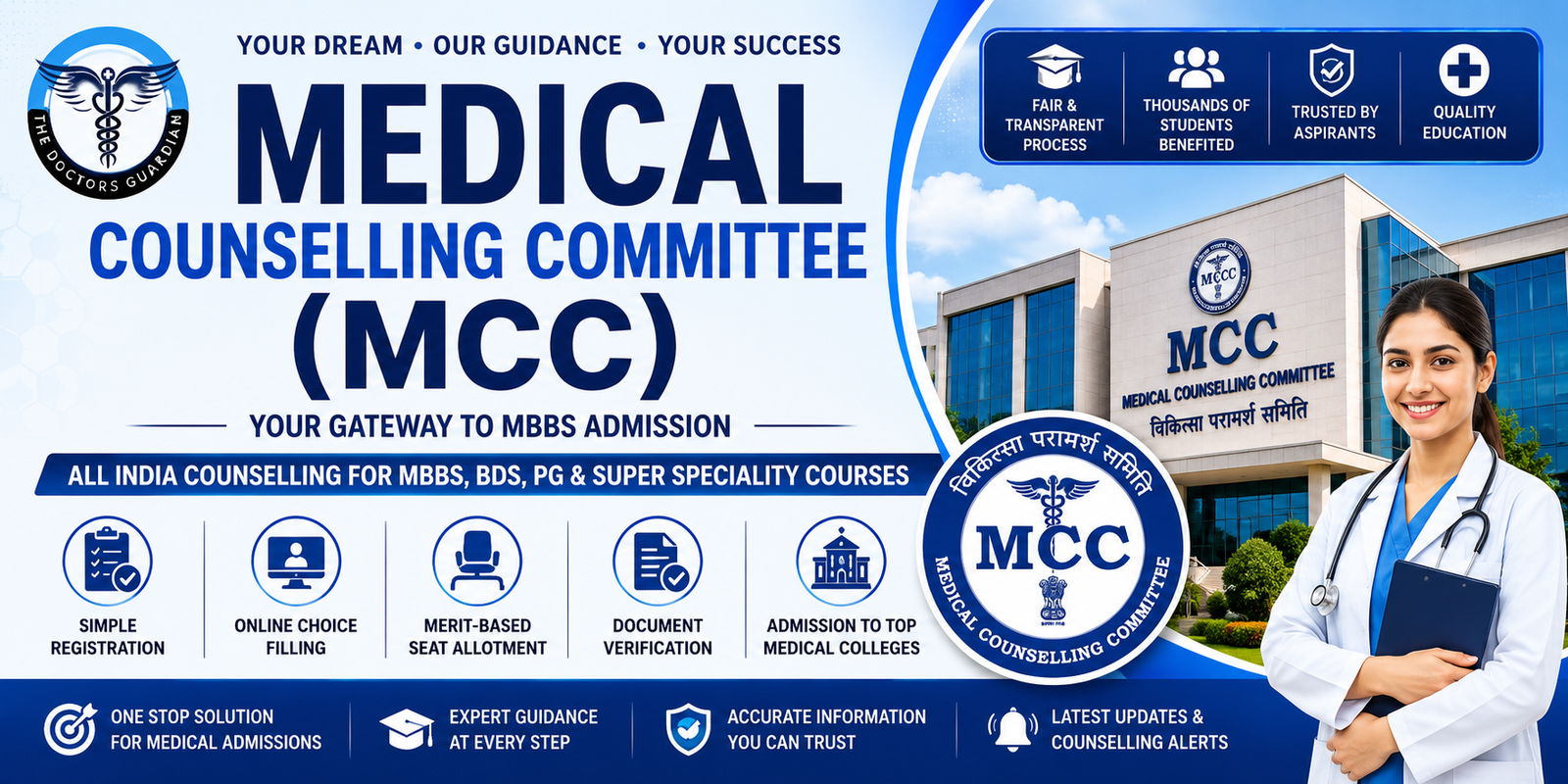
Every year, lakhs of NEET aspirants across India depend on one body to secure their seat in a medical or dental college — the Medical Counselling Committee (MCC). If you are preparing for NEET UG or NEET PG, understanding what MCC is, how it works, and how the counselling process unfolds is just as important as your exam score itself. This detailed guide covers everything you need to know about MCC — its history, organizational structure, functions, role, eligibility, fee structure, reservation policy, round-wise counselling process, common mistakes, and frequently asked questions.
What is MCC (Medical Counselling Committee)?
The Medical Counselling Committee (MCC) is the official body responsible for conducting centralized, merit-based counselling for admission to medical and dental courses in India. MCC operates under the Directorate General of Health Services (DGHS), Ministry of Health and Family Welfare, Government of India.
In simple terms, once you clear NEET, MCC is the authority that converts your NEET rank into an actual seat in a medical college — by managing registration, choice filling, seat allotment, and reporting for specific categories of seats across the country. Many students confuse MCC with a state counselling body, but MCC operates strictly at the national level and only for seats that fall under its jurisdiction — primarily the All India Quota and a handful of specific institutional categories explained later in this article.
If you search “MCC” in the context of NEET, you will almost always land on discussions about registration dates, choice filling, seat allotment results, and the official MCC portal — mcc.nic.in. This makes MCC one of the most searched terms during the NEET admission season, alongside NEET results and counselling schedules.
History of MCC

The Medical Counselling Committee was established on March 23, 2012, by the Government of India to bring order and transparency to what was previously a fragmented admission process. Before MCC existed, candidates had to navigate multiple, inconsistent counselling systems for different quotas and institutions, which made the process confusing and prone to errors, delays, and even malpractice in some cases.
The core objective behind setting up MCC was to consolidate and centralize the counselling process for medical and dental programs, especially given the sheer volume of candidates appearing for national-level medical entrance examinations every year. Prior to the introduction of a single national entrance exam, admissions were scattered across numerous state and institution-specific tests, each with its own counselling mechanism. This fragmentation made it nearly impossible to maintain uniform standards of merit, transparency, and fairness across the country.
Over time, as NEET (National Eligibility cum Entrance Test) became the single, unified entrance examination for medical admissions in India, MCC’s role expanded significantly to cover a wider range of courses and quotas. What began as a body overseeing a limited set of seats gradually grew into the primary national counselling authority responsible for:
- 15% All India Quota (AIQ) seats for MBBS/BDS
- 50% AIQ seats for MD/MS/MDS postgraduate courses
- 100% seats for super-specialty DM/MCh courses
- Seats in central universities, deemed universities, and specific autonomous institutions
This evolution mirrors the broader reforms in India’s medical education regulatory landscape, including the transition from the Medical Council of India (MCI) to the National Medical Commission (NMC), which now oversees medical education standards while MCC continues to focus specifically on the counselling and seat allotment process.
Organizational Structure and Administrative Control
MCC functions as a wing under the Directorate General of Health Services (DGHS), which itself operates under the Ministry of Health and Family Welfare, Government of India. This administrative placement is significant because it positions MCC as a government body directly accountable to the central health ministry, rather than an independent or private entity.
The DGHS provides the necessary administrative and technical support for MCC to function, including maintaining the official counselling portal, coordinating with state authorities and participating institutions, and ensuring that the seat matrix (the list of available seats) is updated and published accurately before each counselling round. MCC also works in close coordination with:
- The National Medical Commission (NMC), which certifies medical colleges and regulates medical education standards
- The National Testing Agency (NTA), which conducts the NEET examination and determines candidate merit and tie-breaking rules
- State counselling authorities, for coordination between the 15% AIQ seats managed by MCC and the 85% state quota seats managed independently by each state
- Participating institutions, including AIIMS, JIPMER, central universities, ESIC colleges, AFMC Pune, and deemed universities
Courses and Quotas Covered by MCC
Understanding exactly which seats fall under MCC’s jurisdiction is essential, because this is one of the most common points of confusion among NEET aspirants.
1. 15% All India Quota (AIQ) — Undergraduate
MCC conducts counselling for 15% of the total MBBS and BDS seats in government medical and dental colleges across India (except Jammu & Kashmir, unless candidates opt in). These seats are open to candidates from any state, regardless of their state of domicile.
2. 50% All India Quota — Postgraduate
For MD, MS, and PG Diploma courses, MCC manages counselling for 50% of the total seats in government medical colleges under the All India Quota.
3. 100% Super-Specialty Seats
All seats for DM and MCh super-specialty courses across India are counselled exclusively through MCC, making it the sole authority for super-specialty admissions.
4. Central Universities and Institutes
MCC conducts counselling for seats in institutions such as:
- Aligarh Muslim University (AMU)
- Banaras Hindu University (BHU)
- University of Delhi (including the Faculty of Dentistry, Jamia Millia Islamia)
- AIIMS institutes across India
- JIPMER, Puducherry
5. ESIC and AFMC Seats
- Seats reserved for wards of ESIC-insured persons in colleges under the Employee State Insurance Corporation
- Armed Forces Medical College (AFMC), Pune
6. Deemed Universities
100% of MBBS/BDS seats in deemed-to-be-university medical colleges are also counselled through MCC, though under a separate fee structure and registration track compared to AIQ seats.
It’s important to note that the remaining 85% of seats in state government medical colleges fall under state quota counselling, which is conducted separately by each state’s own counselling authority — not by MCC. This division between the 15% AIQ (MCC) and 85% state quota (state authorities) is one of the most fundamental things every NEET aspirant needs to understand.
Functions of MCC
MCC performs several critical functions that keep the medical admission ecosystem running smoothly:
1. Seat Allotment
MCC is responsible for allotting seats for undergraduate, postgraduate (medical/dental), and super-specialty courses in government-run, aided colleges, and deemed-to-be-university colleges. Seats are allotted online based on the candidate’s NEET score, with merit, reservation eligibility, and the candidate’s preference list all factored into the decision through a computerized, algorithm-driven allotment process.
2. Managing Quota-Based Counselling
MCC’s scope covers counselling for 15% AIQ undergraduate seats, 50% AIQ postgraduate seats, and 100% super-specialty course seats. It also handles admissions to central universities, deemed universities, and select private colleges certified by the National Medical Commission (NMC).
3. Counselling for Special Institutions
MCC conducts counselling for seats in institutions such as AMU, BHU, the University of Delhi, ESIC colleges, and AFMC Pune, as detailed in the section above.
4. Publishing and Updating the Seat Matrix
Before every round of counselling, MCC releases an updated seat matrix showing the exact number of available seats, category-wise, across all participating institutions. This matrix changes between rounds as seats get filled, vacated, or newly added.
5. Ensuring Legal and Procedural Compliance
Setting up and running the committee ensures admissions happen strictly as per legal guidelines and the seat plan finalized by state governments and regulatory bodies, guaranteeing equal access to medical education for eligible candidates nationwide.
6. Resolving Discrepancies and Grievances
MCC also acts as an adjudicator when disputes or discrepancies arise during counselling, ensuring that procedures follow prescribed guidelines and that every candidate is treated fairly. Candidates can raise grievances through the official helpline or grievance redressal mechanism listed on the MCC website.
7. Fee Collection and Refund Management
MCC manages the collection of registration fees and security deposits, along with processing refunds for candidates who are eligible as per the counselling rules — a function that involves significant coordination with banking partners to ensure timely and accurate disbursement.
Role of MCC in Medical Admissions
The role of MCC goes beyond just allotting seats — it’s the backbone of a transparent and merit-driven admission system in India. Here’s why MCC matters so much for medical aspirants:
- Centralization: Instead of applying separately to multiple colleges or authorities, candidates use a single, unified portal for the seats MCC manages.
- Transparency and Fairness: MCC was established to ensure a fair and transparent admission procedure for undergraduate and postgraduate medical courses.
- Merit-Based Allocation: Every seat allotted through MCC is based on the candidate’s NEET rank, category, and stated preferences — removing scope for manual bias or discretionary allotment.
- Wide Coverage: From MBBS and BDS to MD, MS, MDS, and super-specialty DM/MCh courses, MCC oversees counselling across a significant portion of the medical education pipeline in India.
- National Integration: By allowing candidates from any state to compete for AIQ seats, MCC ensures that meritorious students are not restricted purely by geography.
- Standardization: MCC applies uniform rules, timelines, and documentation requirements across all participating institutions, reducing confusion for candidates dealing with multiple colleges.
Eligibility Criteria for MCC Counselling
To participate in MCC counselling, candidates generally need to meet the following criteria:
- Must have qualified NEET (UG or PG, as applicable) by securing marks at or above the prescribed cutoff percentile for their category.
- Must complete online registration on the official MCC portal within the notified registration window.
- Must meet the minimum age requirement specified for medical admissions.
- Must possess a valid category certificate (SC/ST/OBC-NCL/EWS/PwD) if claiming reservation benefits.
- For deemed university seats, candidates must separately register and pay the applicable higher fee, since deemed university counselling runs on a distinct fee structure from AIQ counselling.
Failure to meet any of these eligibility conditions can lead to cancellation of registration or admission at the document verification stage, even after a seat has been provisionally allotted.
Reservation Policy Under MCC (15% AIQ)
Reservation plays a major role in how seats are distributed under the 15% All India Quota. As per the current central government reservation policy applicable to AIQ seats:
| Category | Reservation Percentage |
|---|---|
| OBC (Non-Creamy Layer) | 27% |
| SC | 15% |
| ST | 7.5% |
| EWS | 10% |
| PwD (horizontal, across all categories) | 5% |
| General/Unreserved | Remaining seats |
This means that a total of 59.5% of AIQ seats are reserved across SC, ST, OBC, and EWS categories, with an additional 5% horizontal reservation for PwD candidates cutting across all vertical categories. It’s worth noting that this AIQ reservation structure is uniform across all states and does not vary — unlike state quota seats, where reservation percentages and categories can differ significantly from state to state.
Candidates must select their correct category at the time of NEET registration and must carry valid, unexpired certificates during MCC counselling and document verification. An expired EWS certificate or an incorrect category selection can result in the candidate being treated as General category, or in the cancellation of an allotted seat.
MCC Counselling Process: Step-by-Step
The MCC counselling process typically follows a structured cycle. While exact dates change every year, the overall procedure remains consistent across counselling seasons.
Step 1: Registration
Candidates register on the official MCC portal (mcc.nic.in) using their NEET roll number and personal details. This usually requires paying a non-refundable registration fee along with a refundable security deposit. Candidates must enter details exactly as they appear in their NEET application records to avoid mismatches during verification.
Step 2: Choice Filling
Once registered, candidates fill in their preferred colleges and courses in order of priority. This list can usually be edited multiple times before the choice-locking deadline. Choices are not saved permanently until the candidate clicks the “Lock” button — unlocked choices may not be considered for allotment, which is one of the most common and costly mistakes candidates make.
Step 3: Seat Allotment
Based on the candidate’s NEET rank, category, and choices submitted, MCC’s system algorithmically allots seats. Tie-breaking criteria, in cases where two or more candidates have identical scores, follow the NEET merit rules prescribed by the National Testing Agency (NTA), which typically consider factors like performance in biology, chemistry, and physics sections, followed by age, in a specified order.
Step 4: Result Declaration
Allotment results are published on the MCC website, showing which candidates have been allotted seats and in which institutions, along with round-wise seat matrices for reference.
Step 5: Reporting and Document Verification
Allotted candidates must report to the designated reporting center or the allotted college within a specified window, carrying original documents for verification.
Step 6: Admission Confirmation
After successful verification, the candidate’s admission is confirmed, and they can begin their academic journey at the allotted institution.
Round-Wise Breakdown
MCC counselling for AIQ seats is typically conducted across the following rounds:
- Round 1: Initial allotment based on merit, category, and preferences submitted during the first choice-filling window.
- Round 2: For candidates not allotted a seat in Round 1, or those seeking to upgrade their allotted seat by submitting fresh or revised choices.
- Mop-Up Round: Conducted after Round 2 to fill vacant seats, primarily relevant for deemed and central university seats. Rules around exiting after this round tend to be stricter, and forfeiting your seat here usually means losing your security deposit as well.
- Stray Vacancy Round: The final round, where colleges fill any remaining vacancies directly, often with a compressed timeline. This is generally considered the last opportunity to secure a seat through centralized counselling for that admission cycle.
Each round has its own registration/participation window (for fresh candidates), choice-filling period, allotment result date, and reporting deadline — all of which are published in the official MCC information bulletin ahead of the counselling season.
MCC Registration Fee and Security Deposit
One of the most confusing aspects of MCC counselling for first-time candidates is the fee structure, since it varies by category and by the type of seat being applied for. Broadly, MCC counselling involves two separate payments:
- A non-refundable registration fee, charged for processing the application.
- A refundable security deposit, held to ensure serious participation and refunded later if the candidate follows the counselling rules correctly.
For 15% AIQ / Central Universities / AFMC / ESIC / AIIMS / JIPMER / B.Sc. Nursing seats:
- Registration fee: Approximately ₹1,000 for General/EWS candidates and ₹500 for SC/ST/OBC/PwD candidates (non-refundable).
- Security deposit: Approximately ₹10,000 for General/EWS candidates and ₹5,000 for SC/ST/OBC/PwD candidates (refundable).
For Deemed University seats:
- Registration fee: A flat, higher non-refundable fee applicable to all categories.
- Security deposit: A significantly higher refundable amount, often around ₹2,00,000, reflecting the different financial structure of private deemed institutions.
If a candidate applies for both government/AIQ seats and deemed university seats in the same cycle, only the higher deemed university fee structure typically applies — not both separately. The refundable security deposit is generally returned to the candidate’s registered bank account within a few weeks after counselling concludes, provided the candidate either did not get allotted a seat, or completed their admission formalities properly without violating exit rules.
Important: Exact fee amounts are revised periodically by MCC and published in the official information bulletin for each counselling cycle. Candidates should always verify the latest fee structure on mcc.nic.in before making any payment, rather than relying on previous years’ figures.
Security Deposit Forfeiture: When You Can Lose Your Money
Understanding forfeiture rules is critical to avoid losing your refundable deposit. Common situations where the security deposit may be forfeited include:
- Not reporting to the allotted college within the specified reporting window after being allotted a seat.
- Exiting or resigning from an allotted seat outside the permitted exit rounds (typically Round 1 exit is allowed without penalty in some cycles, but exits become stricter and often result in forfeiture from Round 2 onward, and especially in the Mop-Up round).
- Providing incorrect or fraudulent information during registration that leads to cancellation of candidature.
- Failing to complete document verification despite being allotted a seat.
Candidates are strongly advised to read the official MCC counselling bulletin’s exit and forfeiture clauses carefully before locking their choices, since these rules can change slightly from year to year.
Documents Required for MCC Counselling
While the exact list may vary slightly by year and category, candidates are generally expected to carry the following original documents (along with photocopies) for verification:
- NEET admit card and scorecard
- Class 10 mark sheet and certificate (for age and identity proof)
- Class 12 mark sheet and certificate
- Valid government-issued photo ID (Aadhaar card, passport, etc.)
- Category/reservation certificate (SC/ST/OBC-NCL/EWS/PwD, if applicable, issued by a competent authority)
- Passport-size photographs (matching the one used during NEET/MCC registration)
- Proof of registration and fee payment receipt
- Provisional/final allotment letter generated by MCC
- Migration certificate and character certificate (as required by the allotted institution)
- Domicile certificate, where relevant for specific quota seats
Candidates with reservation benefits or NRI status must ensure their original category or NRI-eligibility certificates are ready, since online registration does not require document upload immediately — but physical verification at the allotted college absolutely does.
Common Mistakes Candidates Make During MCC Counselling
Even academically strong candidates sometimes lose valuable seats due to avoidable procedural errors. Here are the most common pitfalls to watch out for:
- Not locking choices: Choices filled but not locked before the deadline are not considered for allotment, effectively wasting the round.
- Wrong preference order: Listing colleges based on assumed cutoff ranks rather than genuine preference can result in an unwanted allotment or a missed opportunity to get a better seat.
- Missing the reporting deadline: Failing to report to the allotted college within the specified window leads to automatic forfeiture of the seat.
- Ignoring exit rules: Exiting a seat outside the permitted rounds results in loss of the security deposit.
- Incorrect category selection: Selecting the wrong reservation category, or failing to carry a valid certificate, can lead to the candidate being treated as General category or having their admission cancelled.
- Delayed fee payment: Not completing the registration fee and security deposit payment within the window can prevent participation in that round altogether.
- Mismatched personal details: Entering details that don’t match NEET application records can cause verification failures later.
MCC vs. State Counselling: Key Differences
A frequent point of confusion among NEET candidates is the difference between MCC (national) counselling and state counselling. Here’s a quick comparison:
| Aspect | MCC Counselling | State Counselling |
|---|---|---|
| Seats Covered | 15% AIQ, 50% PG AIQ, 100% super-specialty, central universities, deemed universities | 85% state quota seats in state government/private colleges |
| Conducting Authority | Medical Counselling Committee (DGHS) | Respective state’s medical counselling authority |
| Eligibility | Open to candidates from any state (with some domicile-based exceptions) | Generally restricted to state domicile candidates, with some open seats |
| Reservation Policy | Uniform across India (27% OBC, 15% SC, 7.5% ST, 10% EWS, 5% PwD) | Varies by state; may include additional categories |
| Registration Portal | mcc.nic.in | State-specific counselling websites |
Candidates are generally required to participate in both MCC counselling (for AIQ seats) and their respective state counselling (for state quota seats) to maximize their chances of securing a seat, since these are parallel, independent processes.
MCC vs. National Board of Examinations (NBE)
Another common point of confusion is between MCC and the National Board of Examinations (NBE). While MCC handles AIQ and central institute counselling for MBBS/BDS/MD/MS/MDS/DM/MCh, NBE is responsible for conducting certain postgraduate and diploma examinations and for DNB (Diplomate of National Board) counselling, which follows a separate track from MCC’s MD/MS counselling. Candidates pursuing DNB seats should check NBE’s official channels separately, since DNB counselling is not conducted by MCC.
Frequently Asked Questions (FAQs) About MCC
Why Understanding MCC Matters for NEET Candidates
Many students focus entirely on cracking NEET but underestimate the importance of the counselling stage. A single mistake in choice filling, a missed reporting deadline, or incomplete documentation can cost a candidate their preferred seat — even with a strong NEET rank. Since MCC governs some of the most sought-after seats in the country (AIQ, central universities, ESIC, AFMC, and all super-specialty seats), staying updated with MCC’s official notices, schedules, and rules is essential for every serious medical aspirant.
Beyond just knowing the process, candidates benefit enormously from planning their choice list strategically, keeping documents ready well in advance, tracking the seat matrix updates between rounds, and understanding the financial implications of exiting a seat at different stages. This preparation, alongside strong NEET performance, is what ultimately determines whether a candidate secures their desired medical or dental seat.
Conclusion
The Medical Counselling Committee (MCC) plays an indispensable role in India’s medical education system, ensuring that NEET-qualified candidates get a fair, transparent, and merit-based pathway into medical and dental colleges. From its establishment in 2012 to its current role managing All India Quota, central university, deemed university, and super-specialty counselling, MCC has become the backbone of centralized medical admissions in India. For any NEET aspirant, understanding how MCC works — from eligibility and fees to registration, choice filling, seat allotment, and reporting — is a crucial part of turning exam success into an actual seat in a medical college.
Note: Counselling schedules, fees, reservation rules, and procedures are updated by MCC periodically. Candidates should always cross-check the latest information on the official MCC website (mcc.nic.in) before making any decisions.