Every year, lakhs of medical aspirants eagerly wait for the announcement of the NEET UG qualifying cutoff marks after the declaration of the result. The qualifying cutoff determines whether a candidate is eligible to participate in MBBS, BDS, AYUSH, and other undergraduate medical counselling processes.
It is important to understand that the qualifying cutoff is different from the admission cutoff. While qualifying marks make you eligible for counselling, admission to a Government Medical College usually requires a significantly higher score.
The National Testing Agency (NTA) releases the official category-wise qualifying cutoff along with the NEET result. Until then, expected cutoffs are estimated using exam difficulty, candidate performance, historical trends, and qualifying percentile rules. The qualifying percentile remains fixed by policy (such as the 50th percentile for the General category and the 40th percentile for OBC/SC/ST), while the actual marks change each year depending on overall performance.
This detailed guide from The Doctors Guardian explains the expected category-wise qualifying cutoff, previous year trends, safe scores, and what candidates should do after the results.
What is the NEET Qualifying Cutoff?
The qualifying cutoff is the minimum score required to become eligible for:
- MCC Counselling
- State Counselling
- Government Medical Colleges
- Private Medical Colleges
- Deemed Universities
- BDS Admission
- AYUSH Courses
- Veterinary Courses (where applicable)
If your score is below the qualifying cutoff, you cannot participate in NEET-based counselling.
Qualifying Cutoff vs Admission Cutoff
Many students confuse these two terms.
| Qualifying Cutoff | Admission Cutoff |
|---|---|
| Minimum marks required to qualify NEET | Actual score required to get a seat |
| Released by NTA | Released during counselling |
| Same across India (category-wise percentile) | Varies by college, category, quota, and state |
| Makes you eligible for counselling | Determines whether you get admission |
For example:
A General category student may qualify with around 140–150 marks, but Government MBBS admission usually requires 500–650+ marks, depending on the college and category.
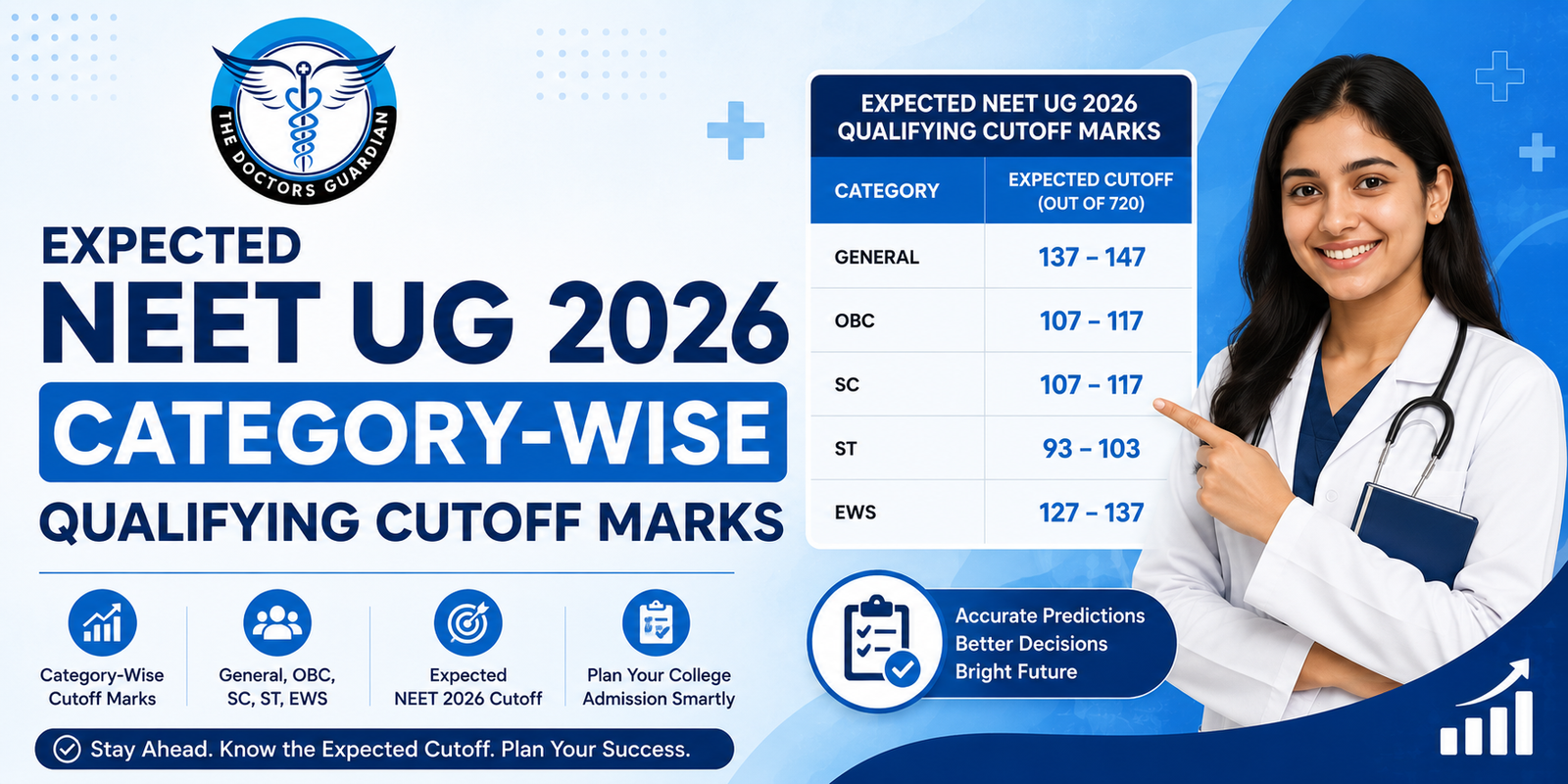
Expected NEET UG 2026 Category-Wise Qualifying Cutoff Marks
The following ranges are expected and will be confirmed only after NTA releases the official result.
| Category | Qualifying Percentile | Expected Cutoff Marks |
|---|---|---|
| General (UR) | 50th Percentile | 140–150 |
| EWS | 50th Percentile | 140–150 |
| OBC | 40th Percentile | 110–120 |
| SC | 40th Percentile | 110–120 |
| ST | 40th Percentile | 110–120 |
| UR-PwD | 45th Percentile | 125–135 |
| OBC-PwD | 40th Percentile | 110–120 |
| SC-PwD | 40th Percentile | 110–120 |
| ST-PwD | 40th Percentile | 110–120 |
These are estimated ranges based on current exam analysis and historical trends. The official qualifying marks will be announced by NTA with the NEET UG 2026 result.
Expected Qualifying Percentile
The qualifying percentile is fixed by regulation:
| Category | Required Percentile |
|---|---|
| General | 50th |
| General-PwD | 45th |
| OBC | 40th |
| SC | 40th |
| ST | 40th |
| OBC/SC/ST-PwD | 40th |
Only the marks corresponding to these percentiles vary from year to year.
Why Does the Cutoff Change Every Year?
Several factors affect the qualifying marks:
1. Difficulty Level
An easier paper generally results in a higher cutoff, while a tougher paper lowers the marks needed to reach the required percentile.
2. Number of Candidates
More candidates increase competition.
3. Overall Performance
Higher average scores usually push the qualifying marks upward.
4. Seat Availability
While the qualifying percentile remains fixed, expanding MBBS seats can influence admission trends.
5. Reservation Policy
Reservation affects admission cutoffs but not the prescribed qualifying percentile.
Previous Year Qualifying Cutoff Trend
| Year | General | OBC/SC/ST |
|---|---|---|
| 2022 | 117 | 93 |
| 2023 | 137 | 107 |
| 2024 | 162 | 127 |
| 2025 | Varies (official) | |
| 2026 | Expected 140–150 | Expected 110–120 |
Values shown are indicative summaries for trend analysis. Refer to official NTA notifications for exact historical cutoffs.
Category-Wise Analysis
General (UR)
- Expected Qualifying Marks: 140–150
- Qualifying Percentile: 50th
Qualifying NEET does not mean Government MBBS admission. Government seats usually require much higher marks.
EWS
The expected qualifying marks are likely to remain similar to the General category because both use the 50th percentile.
OBC
- Expected Qualifying Marks: 110–120
- Percentile: 40th
Admission cutoffs for OBC candidates are generally much higher than the qualifying marks.
SC
Candidates from the SC category are expected to qualify around 110–120 marks, but Government MBBS admission generally requires considerably higher scores.
ST
The expected qualifying range is similar to SC and OBC candidates because all three categories qualify at the 40th percentile.
PwD Categories
PwD candidates have separate qualifying percentile provisions, and the expected marks differ depending on category.
Expected Safe Scores for Government MBBS
These are planning estimates, not qualifying cutoffs.
| Category | Competitive Government MBBS Score |
|---|---|
| General | 610–650+ |
| EWS | 600–640+ |
| OBC | 580–620+ |
| SC | 500–560+ |
| ST | 450–520+ |
These vary significantly by state, counselling quota, and college.
Expected Admission Chances
650+ Marks
Excellent chance for top Government Medical Colleges and premier institutes.
600–649 Marks
Strong Government MBBS opportunities in many states.
550–599 Marks
Good Government or State Quota opportunities depending on category and domicile.
500–549 Marks
Government opportunities become more limited; private and deemed colleges become important options.
Below 500 Marks
Private MBBS, deemed universities, BDS, AYUSH, and MBBS abroad should also be considered.
What Happens After Qualifying NEET?
Once you qualify:
- Download your scorecard.
- Check the official cutoff.
- Estimate your All India Rank.
- Register for MCC counselling.
- Register for your state counselling.
- Prepare all required documents.
- Shortlist colleges according to your score and category.
- Participate in choice filling and seat allotment.
Documents Required for Counselling
- NEET Scorecard
- Admit Card
- Class 10 Certificate
- Class 12 Marksheet
- Identity Proof
- Passport-size Photographs
- Category Certificate (if applicable)
- PwD Certificate (if applicable)
- Domicile Certificate (State Quota)
How The Doctors Guardian Can Help
The Doctors Guardian provides end-to-end MBBS admission guidance, including:
- Government Medical College Counselling
- MCC Counselling
- State Counselling
- Private Medical College Admissions
- Deemed University Counselling
- MBBS Abroad Guidance
- College Prediction
- Choice Filling Strategy
- Document Verification
- Seat Allotment Support
Our expert counsellors help students make informed decisions based on their NEET score, category, budget, and career goals.
Frequently Asked Questions (FAQs)
What is the expected NEET UG 2026 qualifying cutoff for the General category?
The General (UR) category is expected to qualify around 140–150 marks, subject to the official NTA announcement.
What is the expected cutoff for OBC, SC, and ST?
The expected qualifying range for OBC, SC, and ST candidates is 110–120 marks, although the official marks may vary.
Is the qualifying cutoff the same as the admission cutoff?
No. Qualifying cutoff makes you eligible for counselling, while admission cutoff determines whether you secure a seat in a particular college.
Does qualifying NEET guarantee an MBBS seat?
No. Qualifying only makes you eligible to participate in counselling. Admission depends on rank, category, seat availability, and counselling outcomes.
Why do NEET cutoff marks change every year?
The marks change because the qualifying percentile is fixed, but the corresponding score depends on exam difficulty and candidate performance.
When will the official NEET UG 2026 cutoff be released?
NTA will publish the official qualifying cutoff along with the NEET UG 2026 result.
Conclusion
The Expected NEET UG Category-Wise Qualifying Cutoff Marks 2026 provide a useful benchmark for students preparing for the next stage of the admission process. While the expected qualifying ranges suggest approximately 140–150 marks for General/EWS and 110–120 marks for OBC, SC, and ST, these are only estimates. The official qualifying marks will be announced by NTA along with the NEET UG 2026 results.
Remember that qualifying NEET is only the first step. Securing admission to a Government Medical College usually requires a much higher score than the qualifying cutoff. After the results, focus on counselling registration, college selection, and choice filling.
If you need expert guidance, The Doctors Guardian offers comprehensive counselling support for Government, Private, Deemed, and MBBS Abroad admissions, helping you maximize your chances of securing the best possible medical college.