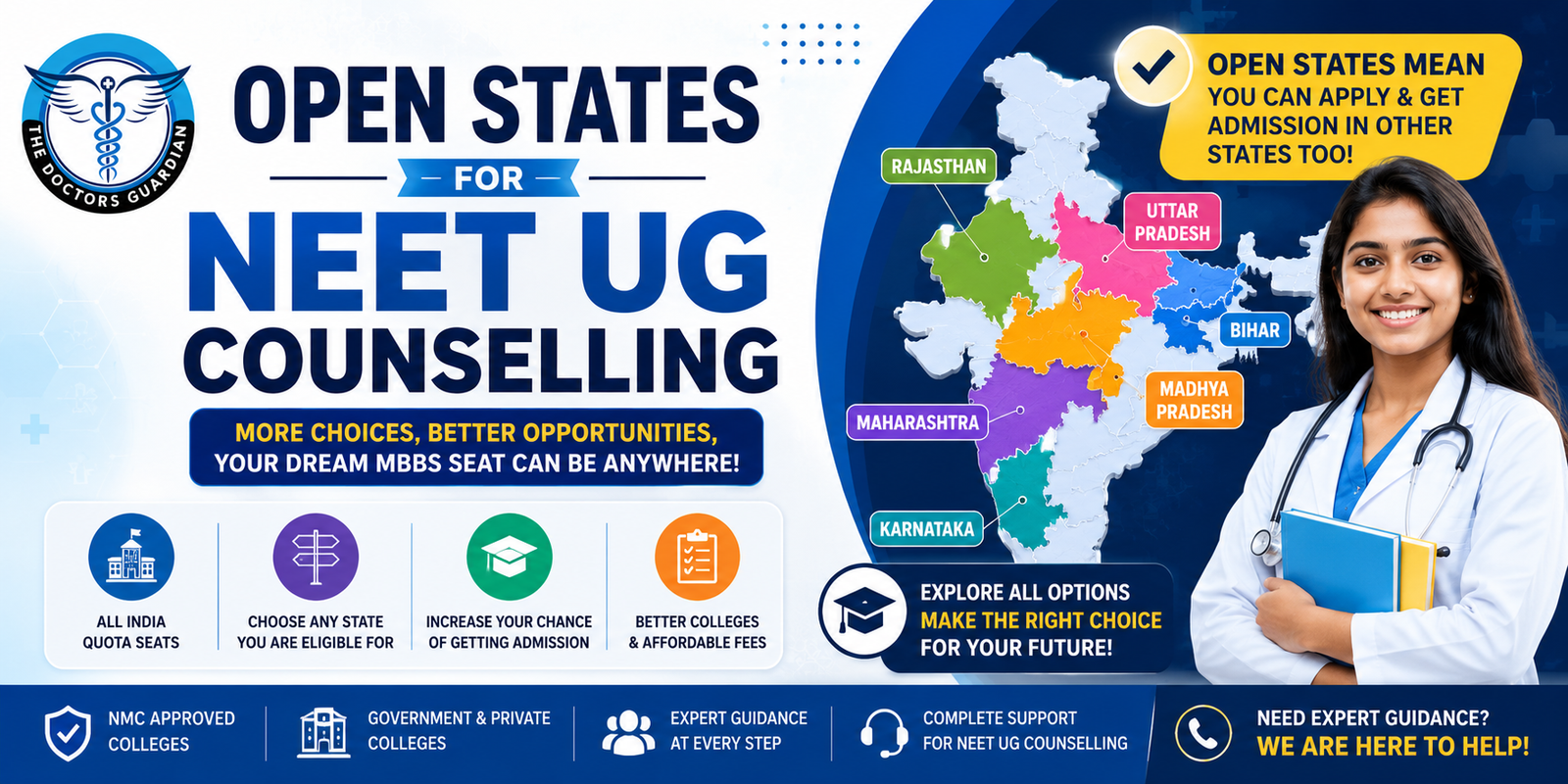
Choosing the right state during NEET UG counselling is one of the most important decisions for MBBS aspirants. Every year, thousands of students miss admission opportunities because they are unaware of the concept of Open States and Closed States in NEET UG counselling.
If you are looking for Open States for NEET UG Counselling 2026, this guide explains what an open state is, which states allow non-domicile candidates to participate in private medical college counselling, eligibility rules, and how to maximize your chances of getting an MBBS seat.
What Are Open States in NEET UG Counselling?
An Open State is a state where students from any part of India can participate in counselling for admission to private medical colleges without requiring a domicile certificate of that state. These admissions are usually available under Management Quota, Private Quota, or NRI Quota, depending on the state’s counselling rules. Eligibility rules vary by state and can change from year to year, so candidates should always verify the latest official counselling notification.
Open states provide additional opportunities for students who may not secure an MBBS seat in their home state.
What Are Closed States?
A Closed State generally restricts private medical college admissions to candidates who meet the state’s domicile or other prescribed eligibility requirements. In such states, students from other states may not be eligible for certain categories of seats. The exact rules differ across states and counselling authorities.
List of Open States for NEET UG Counselling 2026
The following states are generally considered open for admission to private medical colleges for eligible non-domicile candidates, subject to the current year’s counselling rules:
| State | Private Colleges Open for Other State Students |
|---|---|
| Karnataka | Yes |
| Telangana | Yes |
| Andhra Pradesh | Yes |
| Uttar Pradesh | Yes |
| Rajasthan | Yes |
| Haryana | Yes |
| Punjab | Yes |
| Madhya Pradesh | Yes |
| Maharashtra | Yes (subject to eligibility rules) |
| Tamil Nadu | Yes (Private Colleges) |
| Odisha | Yes (Selected Colleges) |
| Chhattisgarh | Yes |
| Bihar | Yes |
| Jharkhand | Yes |
Important: The availability of seats for non-domicile candidates depends on the state’s official counselling policy for that academic year.
States That Generally Follow Closed Counselling
The following states generally reserve most private and government MBBS seats for domicile candidates or have significant eligibility restrictions:
- Gujarat
- Himachal Pradesh
- Jammu & Kashmir
- Assam
- Tripura
- Meghalaya
- Nagaland
- Mizoram
- Arunachal Pradesh
- Sikkim
Candidates should always read the official counselling brochure because eligibility criteria may change every year.
Who Should Apply in Open States?
Open states are beneficial for:
- Students with no domicile advantage outside their home state.
- Candidates targeting private medical colleges.
- Students who narrowly miss government seats.
- NRI candidates.
- Candidates seeking more college options during counselling.
Advantages of Open State Counselling
Some major benefits include:
- More MBBS seat options.
- Higher chances of securing admission.
- Opportunity to compare colleges across multiple states.
- Access to management quota seats.
- Better counselling strategy with multiple registrations.
Government Colleges vs Private Colleges
It is important to understand that the concept of open states mainly applies to private medical colleges.
Government medical colleges generally admit students through:
- 15% All India Quota (AIQ) conducted by MCC.
- 85% State Quota, which usually requires domicile or other state-specific eligibility.
Documents Required
While documents vary by state, candidates generally need:
- NEET UG Scorecard
- NEET Admit Card
- Class 10 Certificate
- Class 12 Marksheet
- Transfer Certificate
- Migration Certificate
- Passport-size Photographs
- Aadhaar Card
- Category Certificate (if applicable)
- Income Certificate (where applicable)
Some states may also require additional documents during admission.
How to Apply for Open State Counselling
The admission process generally involves:
- Qualify NEET UG.
- Register on the official counselling portal of each eligible state.
- Upload the required documents.
- Pay the counselling registration fee.
- Fill and lock college choices.
- Participate in seat allotment.
- Report to the allotted college if selected.
Students can apply to multiple open states simultaneously if they satisfy the eligibility criteria.
Best Open States for MBBS Admission
Some of the most preferred open states include:
Karnataka
Known for a large number of private medical colleges, transparent counselling, and a wide range of management quota seats.
Telangana
Offers several reputed private medical colleges and attracts candidates from across India.
Andhra Pradesh
A preferred destination due to quality private medical institutions and competitive fee structures.
Uttar Pradesh
One of the largest states in terms of private medical colleges and MBBS seat availability.
Rajasthan
Offers several private colleges and attracts candidates through management quota admissions.
Common Mistakes Students Should Avoid
- Registering only in their home state.
- Missing counselling deadlines.
- Not checking eligibility criteria for each state.
- Filling college choices without proper research.
- Ignoring document verification requirements.
- Waiting only for later counselling rounds.
Tips to Improve MBBS Admission Chances
- Apply in multiple open states.
- Participate in all counselling rounds.
- Keep all documents ready before registration.
- Fill as many college choices as possible.
- Track official counselling notifications regularly.
- Prepare a realistic college preference list based on your NEET rank and budget.
Frequently Asked Questions
What is an Open State in NEET UG Counselling?
An Open State allows eligible students from other states to participate in counselling for private medical colleges without requiring that state’s domicile for the applicable seat categories.
Can students from other states get admission to private medical colleges?
Yes. Many states allow non-domicile candidates to compete for private medical college seats through management, private, or NRI quota, depending on the official counselling rules.
Can I apply to multiple open states?
Yes. Candidates can register in multiple state counselling processes if they satisfy the eligibility requirements of each state.
Does an Open State mean government colleges are also open?
No. Government colleges generally fill 15% of seats through the All India Quota and the remaining 85% through the State Quota, which often requires domicile or other state-specific eligibility.
Are counselling rules the same every year?
No. Fee structures, eligibility criteria, seat matrices, and counselling rules may change every year. Candidates should always rely on the latest official notification before applying.
Conclusion
Understanding the concept of Open States for NEET UG Counselling can significantly improve your chances of securing an MBBS seat. By participating in multiple state counselling processes, researching college options, and staying updated with official notifications, you can expand your admission opportunities beyond your home state. Before registering, always verify the latest eligibility criteria, counselling schedule, and seat matrix released by the respective counselling authorities to make informed decisions during NEET UG 2026 admissions.