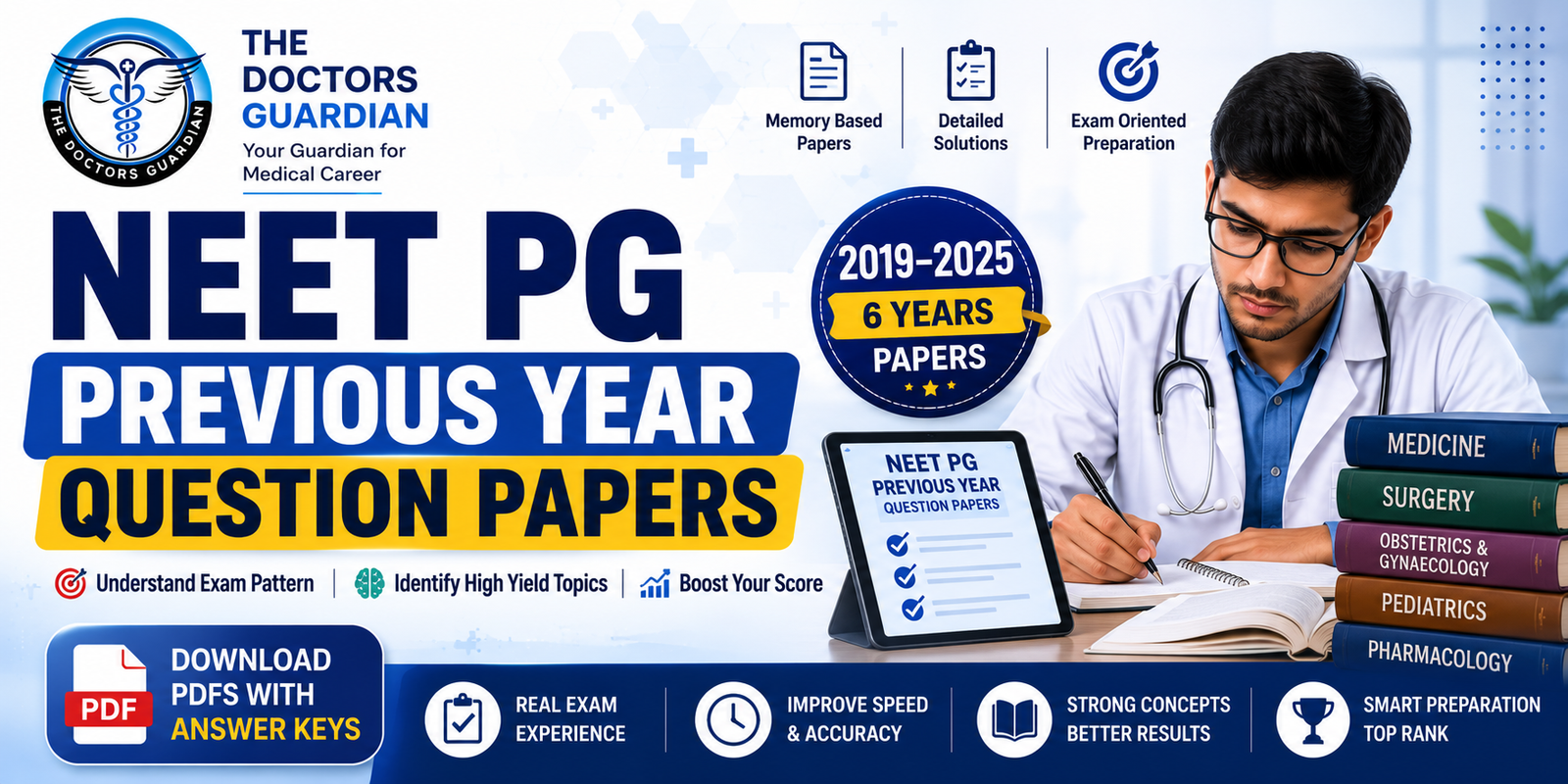
Preparing for NEET PG 2026 requires a smart strategy, and one of the most effective ways to improve your score is by solving previous year question papers (PYQs). Previous year papers help you understand the exam pattern, frequently asked topics, subject-wise weightage, clinical question trends, and difficulty level.
While the actual NEET PG paper is not officially released due to the confidentiality policy followed by the National Board of Examinations in Medical Sciences (NBEMS), several reputed educational platforms provide memory-based previous year question papers with detailed answer keys and explanations. These resources are widely used by aspirants to strengthen conceptual understanding and improve exam readiness.
In this comprehensive guide, you will learn everything about NEET PG Previous Year Question Papers, their importance, year-wise availability, preparation strategy, and how to use them effectively for NEET PG 2026.
Why Should You Solve NEET PG Previous Year Question Papers?
Previous year question papers are among the most valuable study resources because they provide insights into the actual examination pattern.
Some major benefits include:
- Understanding the latest exam pattern
- Identifying high-yield topics
- Improving time management
- Learning clinical problem-solving
- Revising important concepts
- Practising image-based questions
- Analysing strengths and weaknesses
- Increasing confidence before the examination
Most toppers recommend solving at least the previous five years’ question papers before appearing for NEET PG.
NEET PG Exam Pattern 2026
Before solving previous year papers, candidates should understand the examination pattern.
| Particular | Details |
|---|---|
| Examination | NEET PG 2026 |
| Conducting Authority | NBEMS |
| Mode | Computer-Based Test (CBT) |
| Duration | 3 Hours 30 Minutes |
| Total Questions | 200 MCQs |
| Maximum Marks | 800 |
| Marks for Correct Answer | +4 |
| Negative Marking | -1 |
| Subjects Covered | 19 MBBS Subjects |
The exam is primarily clinical and concept-based, with increasing emphasis on integrated learning and image-based questions.
NEET PG Previous Year Question Papers (2019–2025)
Candidates preparing for NEET PG 2026 should practise the following memory-based papers:
| Year | Question Paper | Answer Key |
|---|---|---|
| NEET PG 2025 | Available | Available |
| NEET PG 2024 | Available | Available |
| NEET PG 2023 | Available | Available |
| NEET PG 2022 | Available | Available |
| NEET PG 2021 | Available | Available |
| NEET PG 2020 | Available | Available |
| NEET PG 2019 | Available | Available |
Several reputed educational platforms provide these papers with detailed explanations and subject-wise categorisation.
Subject-wise Importance of Previous Year Questions
Almost every MBBS subject contributes questions to NEET PG.
High-weightage subjects include:
| Subject | Importance |
|---|---|
| Medicine | Very High |
| Surgery | Very High |
| Obstetrics & Gynaecology | High |
| Pathology | High |
| Pharmacology | High |
| Microbiology | High |
| PSM | High |
| Pediatrics | High |
| Anatomy | Moderate |
| Physiology | Moderate |
| Biochemistry | Moderate |
| Orthopedics | Moderate |
| ENT | Moderate |
| Ophthalmology | Moderate |
| Dermatology | Moderate |
| Psychiatry | Moderate |
| Radiology | Moderate |
| Anaesthesia | Moderate |
| Forensic Medicine | Moderate |
Many educational platforms also publish subject-wise PYQ compilations to help students revise important topics efficiently.
Why Previous Year Questions Matter
NEET PG has gradually shifted from direct factual questions to application-based clinical scenarios.
Previous year papers help candidates understand:
- Clinical case discussions
- Integrated concepts
- Frequently repeated diseases
- Investigation-based questions
- Pharmacology applications
- Image interpretation
- ECG interpretation
- Radiology questions
- Histopathology images
- Instruments
- Clinical management protocols
Repeated exposure to these question types improves analytical thinking.
How to Use Previous Year Question Papers Effectively
Many students solve PYQs only once before the exam. This is not the correct approach.
A better strategy is:
First Reading
Solve the entire paper without checking answers.
Second Reading
Review every explanation carefully.
Third Reading
Identify weak topics.
Fourth Reading
Revise standard notes for those topics.
Fifth Reading
Attempt the same paper again after one month.
This method improves retention and accuracy.
Commonly Repeated Topics in NEET PG
Although exact questions are not repeated frequently, several themes appear regularly.
Some important topics include:
Anatomy
- Cranial nerves
- Upper limb
- Lower limb
- Embryology
Physiology
- CVS
- Respiratory physiology
- Renal physiology
Biochemistry
- Metabolism
- Molecular biology
- Vitamins
Pharmacology
- Autonomic drugs
- Antibiotics
- CNS drugs
Pathology
- Neoplasia
- Inflammation
- Haematology
Medicine
- Cardiology
- Endocrinology
- Neurology
- Infectious diseases
Surgery
- Trauma
- Thyroid
- Breast
- Gastrointestinal surgery
Obstetrics & Gynaecology
- Labour
- Pregnancy complications
- Contraception
Pediatrics
- Vaccination
- Neonatal care
- Nutrition
Benefits of Solving the Last Five Years’ Papers
Students who regularly solve previous year papers generally experience:
- Faster question-solving speed
- Better clinical reasoning
- Improved recall
- Reduced exam anxiety
- Better revision
- Higher mock test scores
- Better rank prediction
PYQs are also useful for identifying topics that appear repeatedly across multiple years.
Mistakes Students Make While Solving PYQs
Avoid these common mistakes:
- Memorising answers without understanding concepts
- Ignoring explanations
- Solving papers only once
- Skipping image-based questions
- Not analysing mistakes
- Avoiding weak subjects
- Not maintaining an error notebook
How Many Previous Year Papers Should You Solve?
Experts generally recommend solving:
- Last 5 years completely
- Subject-wise PYQs
- Image-based PYQs
- Clinical scenario questions
- Integrated questions
This provides sufficient exposure to the latest exam trends.
PYQs vs Mock Tests
| Previous Year Questions | Mock Tests |
|---|---|
| Real exam trend | Simulated exam |
| High-yield topics | Overall preparation |
| Repeated concepts | Time management |
| Actual difficulty level | Performance analysis |
| Best for revision | Best for self-assessment |
Both should be part of your preparation strategy.
Best Time to Solve Previous Year Papers
You can divide your preparation into three phases.
Phase 1
Complete syllabus.
Phase 2
Solve previous year papers subject-wise.
Phase 3
Attempt full-length previous year papers under exam conditions.
Preparation Strategy Using Previous Year Papers
An effective preparation plan includes:
Morning
- Solve one subject-wise PYQ section.
Afternoon
- Read explanations.
- Revise related notes.
Evening
- Practise MCQs from the same topic.
Weekend
- Attempt one full-length previous year paper.
Additional Resources Along with PYQs
Previous year papers should be combined with:
- Standard MBBS notes
- Question banks
- Grand Tests
- Image-based revision
- Clinical case discussions
- Mock examinations
- Rapid revision notes
This combination helps build conceptual clarity and exam confidence.
Tips to Score Higher Using PYQs
- Solve papers in timed mode.
- Analyse every incorrect answer.
- Maintain an error notebook.
- Revise frequently repeated topics.
- Focus on image-based questions.
- Practise integrated clinical scenarios.
- Attempt full-length papers before the exam.
- Revise explanations multiple times.
Frequently Asked Questions
Are NEET PG previous year question papers available officially?
No. Due to NBEMS confidentiality rules, official question papers are not publicly released. However, reputed educational platforms publish memory-based question papers with answer keys and explanations.
How many years of previous papers should I solve?
Most experts recommend solving at least the last five years of NEET PG previous year papers along with subject-wise PYQs.
Do questions repeat in NEET PG?
Exact questions rarely repeat, but concepts, clinical scenarios, and high-yield topics often recur in different formats.
Are previous year papers enough for NEET PG preparation?
No. Previous year papers are an excellent revision tool, but they should be supplemented with standard notes, question banks, mock tests, and regular revision.
When should I start solving previous year papers?
It is advisable to begin after completing a substantial portion of the syllabus. Many candidates solve subject-wise PYQs during preparation and reserve full-length papers for the final months before the exam.
Conclusion
NEET PG Previous Year Question Papers remain one of the most valuable resources for exam preparation. They help candidates understand the evolving exam pattern, improve clinical reasoning, identify high-yield topics, and strengthen time management skills. Solving the last five years of memory-based papers, reviewing detailed explanations, and combining PYQs with mock tests and regular revision can significantly improve your performance. For NEET PG 2026 aspirants, consistent practice of previous year questions should be an essential part of the preparation strategy to maximise accuracy and achieve a better rank.