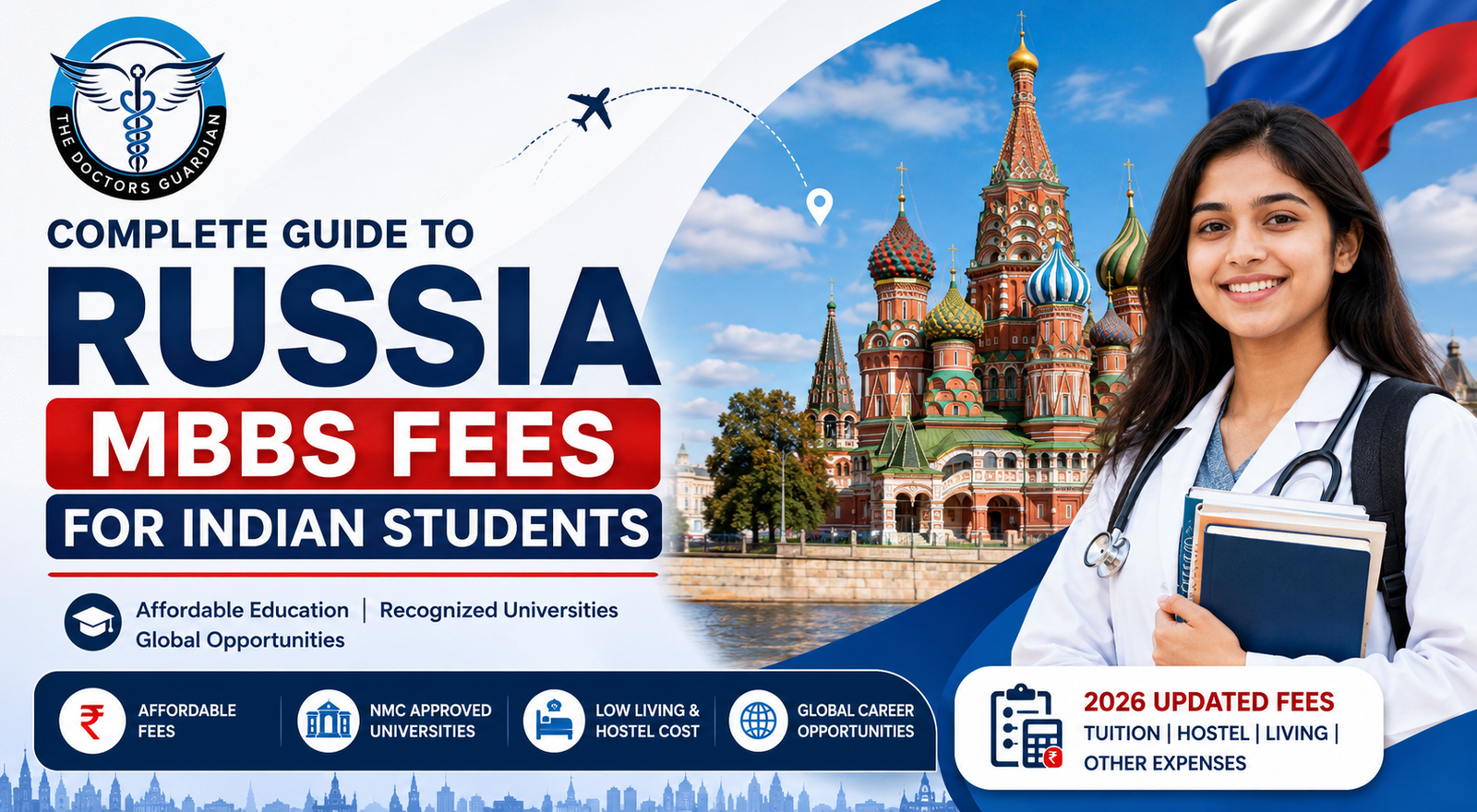
MBBS in Russia continues to be one of the most searched — and most misunderstood — options for Indian students planning to study medicine abroad in 2026. Search for “Russia MBBS fees” and you’ll find one site quoting ₹15 lakh and another quoting ₹50 lakh for what looks like the same course. Neither figure is wrong. The gap almost always comes down to what’s counted: tuition alone versus tuition plus hostel, insurance, food, visa costs, and six years of living expenses.
This guide breaks down the real, all-inclusive Russia MBBS fees for Indian students in 2026 — university by university — so you can build an actual budget instead of guessing between two extreme numbers.
Russia MBBS Fees 2026: Quick Snapshot
| Cost Component | Typical Range (Annual) | Typical Range (6-Year Total) |
|---|---|---|
| Tuition Fee | ₹2.3 lakh – ₹7.5 lakh | ₹14 lakh – ₹45 lakh |
| Hostel Fee | ₹25,000 – ₹2.4 lakh | ₹1.5 lakh – ₹14 lakh |
| Food/Mess (if opted) | ₹1 lakh – ₹1.3 lakh | ₹6 lakh – ₹7.8 lakh |
| Medical Insurance | ₹8,000 – ₹18,000 | ₹50,000 – ₹1 lakh |
| Visa & Admin (one-time) | ₹8,000 – ₹50,000 | One-time |
| All-Inclusive Total (6 yrs) | — | ₹18 lakh – ₹50 lakh |
Most Indian students land in the ₹20–35 lakh bracket for a solid, NMC-listed university once every recurring cost is added in. Premium Moscow/St. Petersburg universities such as Sechenov and RUDN run considerably higher.
Get Free Admission Guidance — Talk to an Expert Today
- Expert Guidance for Admission
- Step-by-step Counselling Support
Note: All figures are approximate and calculated using an indicative exchange rate of ₹1 RUB ≈ ₹1.10–1.26 and ₹1 USD ≈ ₹90–92. Rates fluctuate constantly — always confirm the current conversion and the university’s official 2026 fee notice before applying.
University-Wise MBBS Fees in Russia for Indian Students (2026)
Russian medical universities are broadly grouped into three cost tiers. Here’s how the popular NMC-approved options compare.
Tier 1 — Premium Federal/Research Universities (Moscow & St. Petersburg)
| University | City | Annual Tuition (approx.) | 6-Year Total (approx.) |
|---|---|---|---|
| Sechenov University | Moscow | $7,000 – $8,000 | ₹42 lakh – ₹55 lakh |
| RUDN University | Moscow | $6,500 – $7,500 | ₹40 lakh – ₹50 lakh |
| Pirogov Russian National Research Medical University (RNRMU) | Moscow | $6,000 – $7,500 | ₹38 lakh – ₹48 lakh |
| Saint Petersburg State University | St. Petersburg | $6,000 – $7,000 | ₹36 lakh – ₹46 lakh |
Tier 2 — Established State Medical Universities (Mid-Range)
| University | City | Annual Tuition (approx.) | 6-Year Total (approx.) |
|---|---|---|---|
| Kazan Federal University | Kazan | ₹4.2 lakh – ₹5.5 lakh | ₹35 lakh – ₹42 lakh |
| Kazan State Medical University | Kazan | ₹3.8 lakh – ₹5 lakh | ₹30 lakh – ₹38 lakh |
| Volgograd State Medical University | Volgograd | ₹3.5 lakh – ₹4.5 lakh | ₹26 lakh – ₹32 lakh |
| Kursk State Medical University | Kursk | ₹3.3 lakh – ₹4.3 lakh | ₹24 lakh – ₹30 lakh |
| Mari State University | Yoshkar-Ola | ₹3.2 lakh – ₹4.2 lakh | ₹25 lakh – ₹28 lakh |
| Orenburg State Medical University | Orenburg | ₹3 lakh – ₹4 lakh | ₹22 lakh – ₹28 lakh |
Tier 3 — Budget Regional State Universities
| University | City | Annual Tuition (approx.) | 6-Year Total (approx.) |
|---|---|---|---|
| Crimea Federal University | Simferopol | ₹2.4 lakh – ₹3.4 lakh | ₹18 lakh – ₹25 lakh |
| Altai State Medical University | Barnaul | ₹2.5 lakh – ₹3.5 lakh | ₹20 lakh – ₹26 lakh |
| Orel State Medical University | Orel | ₹2.3 lakh – ₹3.2 lakh | ₹18 lakh – ₹22 lakh |
| Bashkir State Medical University | Ufa | ₹2.6 lakh – ₹3.6 lakh | ₹20 lakh – ₹26 lakh |
Fee ranges above bundle tuition and typical hostel charges based on multiple 2026 university fee notices and consultancy disclosures. Actual quotes vary by intake, faculty, and current exchange rate — always cross-check against the university’s official admission office or the WHO World Directory of Medical Schools (WDOMS) listing before paying anything.
What’s Actually Included in the “Total MBBS Fee” Figure
This is where most confusion happens. When a website advertises “MBBS in Russia for ₹18 lakh,” it is usually quoting tuition only — not the full cost of living and studying there for six years. A realistic all-inclusive figure should account for:
- Tuition fee — charged annually or per semester, fixed for the full course in most government universities
- Hostel accommodation — usually on-campus, sometimes bundled into the tuition invoice
- Food/mess charges — compulsory in some universities during Year 1, optional (self-cooking allowed) afterward
- Medical insurance — mandatory for all international students, renewed annually
- One-time admission/administrative charges — paid only in Year 1
- Visa fees, flights, and document attestation
- Personal and miscellaneous living expenses
A fee comparison that leaves out even two or three of these will look artificially cheap — which is exactly why the “₹15 lakh” and “₹45 lakh” headlines you see online can both be technically true.
Hostel, Food & Living Costs in Russia for Indian Students
| Expense | Monthly Cost (approx.) | Annual Cost (approx.) |
|---|---|---|
| Hostel Accommodation | ₹2,000 – ₹8,000 (bundled in most cases) | ₹25,000 – ₹2.4 lakh |
| Food (self-cooked) | ₹6,000 – ₹10,000 | ₹72,000 – ₹1.2 lakh |
| Indian Mess (where compulsory) | $100 – $125 | ₹1 lakh – ₹1.3 lakh |
| Local Transport | ₹1,500 – ₹3,000 | ₹18,000 – ₹36,000 |
| Personal/Miscellaneous | ₹3,000 – ₹6,000 | ₹36,000 – ₹72,000 |
| Total Monthly Living Cost | ₹100 – ₹300 (in USD terms) | ₹1.5 lakh – ₹3 lakh/year |
Cities like Kazan, Volgograd, and Crimea are noticeably cheaper to live in than Moscow or St. Petersburg, where rent, transport, and daily expenses can run two to three times higher.
Visa, Insurance & Hidden Costs Students Often Miss
Beyond tuition and hostel, budget for these recurring or one-time costs — they add up to a meaningful chunk of the six-year total if ignored:
- Student visa fee: roughly ₹8,000–₹10,000, renewed annually in most cases
- Return flights (Delhi/Mumbai to Russia): ₹50,000–₹70,000 per round trip, so budget for at least one visit home per year if planned
- HIV test and medical fitness report: required before departure, ₹3,000–₹5,000
- Document attestation (apostille/embassy): ₹5,000–₹8,000
- Compulsory medical insurance: ₹8,000–₹18,000 per year, non-negotiable for the student visa
- Migration card and residence permit renewal: minor annual administrative charges
- FMGE/NExT coaching (post-return): ₹40,000–₹1.2 lakh, optional but recommended in the final year
- Currency conversion losses: RUB and USD exchange rates fluctuate through the year, which can shift your annual fee by a few thousand rupees either way
None of these are “extra” costs in the sense that they’re avoidable — they’re simply the parts that flat “tuition-only” advertisements leave out.
Russia MBBS Cost vs Private Medical Colleges in India
For families weighing Russia against a private MBBS seat in India, the cost gap is the single biggest deciding factor.
| Parameter | MBBS in Russia | Private Medical College in India |
|---|---|---|
| Total Course Cost (6 yrs incl. living) | ₹20 lakh – ₹50 lakh | ₹60 lakh – ₹1.5 crore+ |
| Donation/Capitation Fee | None (government universities) | Common in management quota seats |
| Entrance Exam for Admission | Not required (NEET only for eligibility, not selection) | NEET rank-dependent, highly competitive |
| Course Duration | 6 years (incl. 1-year internship) | 5.5 years (incl. 1-year internship) |
| Degree Recognition | NMC/WHO-listed, valid after clearing FMGE/NExT | Directly valid in India |
| Clinical Exposure Language | English (theory) + Russian (clinical years) | English/Hindi/regional language |
Russia is significantly cheaper and avoids donation-based admissions, but it comes with a trade-off: graduates must clear the FMGE/NExT screening exam to practise in India, and the last two to three years of clinical rotations typically require working knowledge of Russian.
MBBS in Russia: Eligibility Criteria for Indian Students (2026)
- Minimum age of 17 years by December 31 of the admission year
- Passed 10+2 with Physics, Chemistry, and Biology (PCB) from a recognized board
- Minimum 50% aggregate in PCB for General category; 40% for SC/ST/OBC as per NMC norms
- A valid, qualifying NEET-UG score (NEET is mandatory for all Indian students planning to study medicine abroad, per NMC rules effective since 2018)
- No separate entrance test is conducted by Russian universities for admission — NEET qualification and academic marks are sufficient
Admission Process: Step-by-Step
- Shortlist NMC/WHO-approved universities listed on the WDOMS directory
- Submit scanned documents — 10th and 12th mark sheets, passport, NEET scorecard, photographs
- Receive the admission/invitation letter from the university, usually within 7–15 days
- Apply for the student visa at the Russian consulate using the invitation letter
- Pay the Year 1 fee — either via bank transfer before departure or in cash/card after arrival, depending on the university’s accepted method
- Travel to Russia, complete document verification and medical check-in at the university
- Begin the academic year, typically starting in September
Admission windows for the 2026–27 session generally run from April to August, with September being the primary intake month across almost all Russian medical universities.
Documents Required for MBBS Admission in Russia
- 10th and 12th mark sheets and passing certificates
- Valid passport (minimum 18 months validity at the time of application)
- NEET-UG scorecard (current year or either of the previous two years)
- Passport-size photographs (as per visa specifications)
- HIV test report and general medical fitness certificate
- Transfer/migration certificate from the previous educational institution
- Birth certificate
- Notarized/apostilled translations of academic documents, where required
NMC Guidelines Indian Students Must Know Before Choosing Russia
The National Medical Commission (NMC) has specific requirements that directly affect whether a Russian MBBS degree will let you practise in India:
- The university must be listed in the WHO World Directory of Medical Schools (WDOMS)
- The MBBS course must run for a minimum of 4.5 years (54 months) of academic study plus a 12-month internship
- NEET-UG qualification is mandatory for any Indian student pursuing a medical degree abroad — without it, the degree cannot be used to appear for the licensing exam in India
- Graduates must clear the FMGE (Foreign Medical Graduate Examination) or NExT screening exam before registering to practise medicine in India
- Students are expected to complete their entire course and mandatory internship in the same country where they enrolled, per current NMC regulations — always confirm the latest circulars, as these guidelines are periodically updated
Because these rules are revised from time to time, cross-check the current NMC and WDOMS listings directly before finalizing any university.
Money-Saving Tips for MBBS in Russia
- Compare Tier 2 and Tier 3 universities carefully — many offer the same NMC recognition and similar FMGE outcomes as premium Moscow universities at nearly half the cost
- Ask about full-course fixed fee structures — some universities lock the tuition rate for all six years, protecting you from annual fee hikes
- Avoid “subsidized fee” packages sold by unauthorized agents — legitimate Russian universities do not offer bulk-discounted six-year payment schemes; verify every fee quote directly with the university’s official admission office
- Cook your own food where allowed — self-catering can cut monthly food costs by 30–40% compared to mandatory mess plans
- Apply for merit-based scholarships — several universities offer partial to full tuition waivers based on academic performance
- Pay via authorized bank transfer, not cash-in-hand to agents, to avoid double payment or fraud risk
- Track the RUB/USD-INR exchange rate before each annual payment cycle — timing your transfer can save a meaningful amount over six years
Frequently Asked Questions
1. What is the total MBBS fee in Russia for Indian students in 2026? The all-inclusive six-year cost typically ranges between ₹18 lakh and ₹50 lakh, depending on the university and city. Budget regional universities such as Crimea Federal or Orel State fall on the lower end, while premium Moscow-based universities like Sechenov and RUDN sit at the higher end. This figure usually covers tuition, hostel, insurance, and basic living costs, but always verify the latest official fee notice before applying.
2. Which is the cheapest university for MBBS in Russia? Crimea Federal University, Orel State Medical University, and Altai State Medical University are among the most affordable NMC-approved options, with six-year all-inclusive costs generally between ₹18 lakh and ₹25 lakh. These universities offer the same WDOMS recognition as pricier options, making them popular with budget-conscious families, though living costs and infrastructure vary by city.
3. Is NEET mandatory for MBBS in Russia? Yes. NEET-UG qualification is mandatory for every Indian student pursuing a medical degree abroad, including in Russia. This is an NMC requirement, not a Russian university requirement, so Russian universities themselves do not conduct a separate entrance exam. Without a qualifying NEET score, you cannot later appear for the FMGE/NExT licensing exam required to practise in India.
4. Does the MBBS fee in Russia include hostel and food? In most universities, hostel accommodation is bundled with or billed alongside the tuition invoice. Food is often separate — some universities have a compulsory Indian mess in Year 1 costing roughly $100–$125 per month, while later years usually allow self-cooking, which is considerably cheaper. Always ask for an itemized fee breakdown before enrolling.
5. How much does MBBS in Russia cost compared to private colleges in India? MBBS in Russia typically costs ₹20 lakh to ₹50 lakh for the full six-year course, compared to ₹60 lakh to ₹1.5 crore or more at private medical colleges in India. Russian government universities also don’t charge donation or capitation fees, which are common in Indian private-college management quota seats, making Russia a significantly more affordable route to an MBBS degree.
6. Can I get a scholarship for MBBS in Russia? Yes, many Russian universities offer merit-based scholarships to international students, including Indian applicants, ranging from partial tuition waivers to full coverage in exceptional cases. Eligibility is usually based on 12th-grade academic performance and, in some cases, NEET scores. Scholarship availability and criteria vary by university and should be confirmed directly with the admissions office each intake year.
7. What is the total cost of living per month in Russia for Indian students? Monthly living expenses for Indian students typically range between $100 and $300, or roughly ₹9,000 to ₹27,000, depending on the city and lifestyle. Regional cities like Kazan, Volgograd, and Crimea are considerably cheaper than Moscow or St. Petersburg, where rent and daily costs can be two to three times higher.
8. Is MBBS from Russia valid in India? Yes, an MBBS degree from an NMC-listed, WDOMS-recognized Russian university is valid in India, provided the graduate clears the FMGE or NExT screening exam after returning. The degree alone does not permit practice in India — passing the licensing exam is a mandatory additional step for all foreign medical graduates, regardless of which country they studied in.
9. Do Russian medical universities charge donation or capitation fees? No. Government-run Russian medical universities follow a fixed, transparent fee structure with no donation or capitation charges, unlike many private medical colleges in India. This is one of the main reasons Russia has become a popular alternative for students who qualify for a medical seat on merit but can’t afford India’s private-college fees.
10. How do I verify if a Russian university is genuinely NMC-approved? Check the university’s listing on the WHO World Directory of Medical Schools (WDOMS) at wdoms.org, and cross-reference it with the current NMC screening regulations for foreign medical graduates. Avoid relying solely on an agent’s claim — request the university’s official accreditation documents and, where possible, confirm directly through the university’s international admissions office.