NEET PG is one of the most competitive postgraduate medical entrance examinations in India. Every year, thousands of MBBS graduates compete for limited MD, MS, PG Diploma, and DNB seats. Since the syllabus includes all 19 MBBS subjects, understanding the subject-wise weightage is one of the smartest ways to prepare effectively.
Although the National Board of Examinations in Medical Sciences (NBEMS) does not officially release a fixed subject-wise question distribution, analysis of previous years’ exams shows consistent trends. Clinical subjects such as General Medicine, General Surgery, Obstetrics & Gynaecology, Pathology, Pharmacology, and Community Medicine (PSM) contribute a significant portion of the paper.
This guide provides a detailed analysis of the NEET PG 2026 subject-wise weightage, expected number of questions, preparation strategy, high-yield topics, and study plan.
NEET PG 2026 Exam Pattern
Before understanding the weightage, candidates should know the latest exam pattern.
| Particular | Details |
|---|---|
| Exam Name | NEET PG 2026 |
| Conducting Authority | NBEMS |
| Mode of Examination | Computer-Based Test (CBT) |
| Question Type | Multiple Choice Questions (MCQs) |
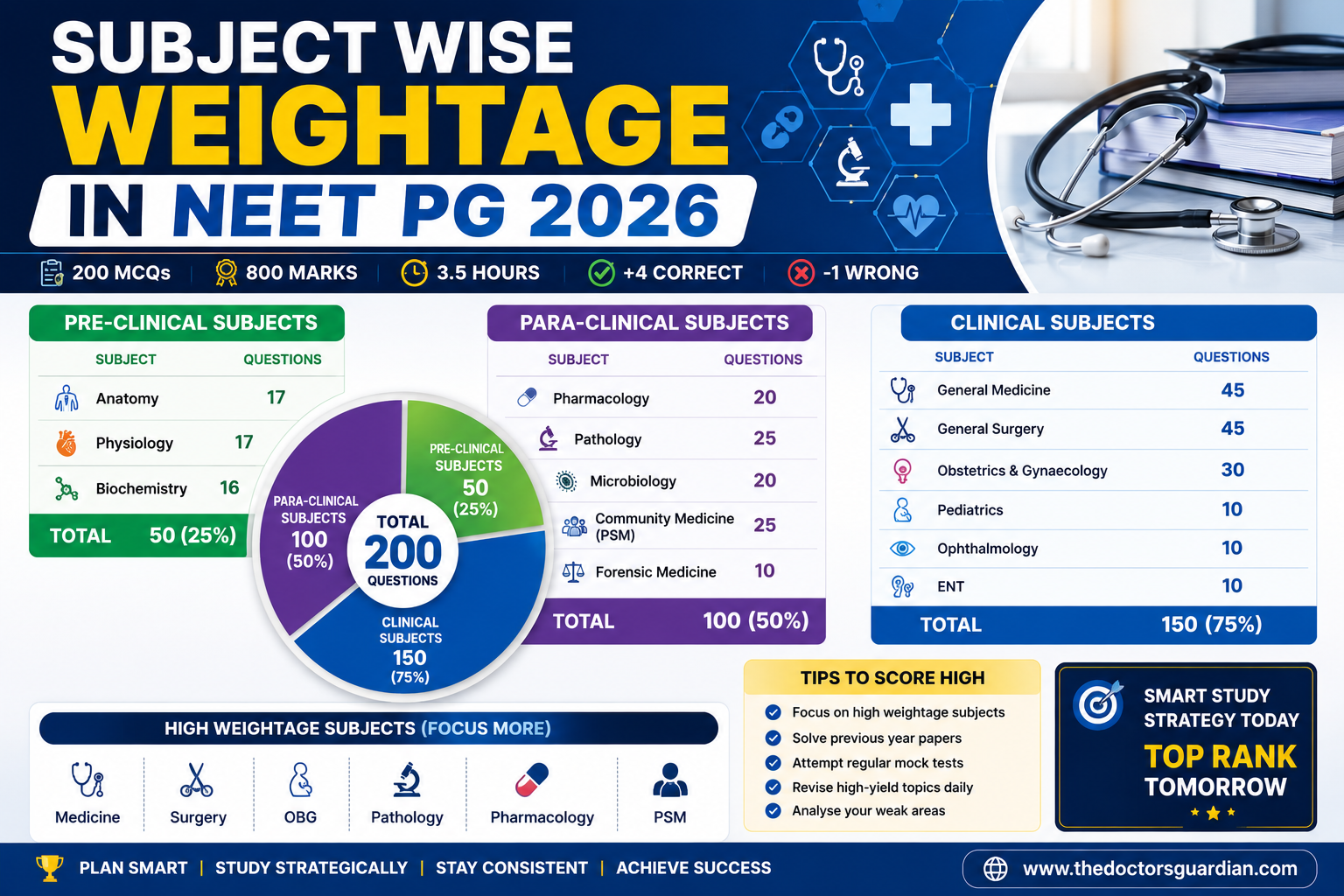
| Total Questions | 200 |
| Maximum Marks | 800 |
| Duration | 3 Hours 30 Minutes |
| Correct Answer | +4 Marks |
| Wrong Answer | -1 Mark |
| Unanswered | 0 Marks |
Candidates should note that NBEMS may revise the exam pattern through official notifications, so always verify the latest information before the examination.
NEET PG Subject Wise Weightage 2026
The following distribution is based on previous years’ exam analysis and is commonly used by aspirants for preparation planning.
| Subject | Expected Questions | Weightage |
|---|---|---|
| General Medicine (Including Dermatology, Psychiatry & Venereology) | 45 | Very High |
| General Surgery (Including Orthopaedics, Anaesthesia & Radiodiagnosis) | 45 | Very High |
| Obstetrics & Gynaecology | 30 | High |
| Pathology | 25 | High |
| Community Medicine (PSM) | 25 | High |
| Pharmacology | 20 | High |
| Microbiology | 20 | High |
| Anatomy | 17 | Moderate |
| Physiology | 17 | Moderate |
| Biochemistry | 16 | Moderate |
| Pediatrics | 10 | Moderate |
| Ophthalmology | 10 | Moderate |
| ENT | 10 | Moderate |
| Forensic Medicine | 10 | Moderate |
These figures are based on historical trends and are not officially prescribed by NBEMS.
Distribution of Subjects
Part A – Pre-Clinical Subjects
| Subject | Questions |
|---|---|
| Anatomy | 17 |
| Physiology | 17 |
| Biochemistry | 16 |
| Total | 50 |
Part B – Para-Clinical Subjects
| Subject | Questions |
|---|---|
| Pharmacology | 20 |
| Pathology | 25 |
| Microbiology | 20 |
| Community Medicine (PSM) | 25 |
| Forensic Medicine | 10 |
| Total | 100 |
Part C – Clinical Subjects
| Subject | Questions |
|---|---|
| Medicine | 45 |
| Surgery | 45 |
| Obstetrics & Gynaecology | 30 |
| Pediatrics | 10 |
| Ophthalmology | 10 |
| ENT | 10 |
| Total | 150 |
This distribution illustrates why clinical subjects dominate the examination.
Highest Weightage Subjects in NEET PG
Candidates should devote maximum preparation time to the following:
1. General Medicine
Medicine is consistently the highest-weightage subject.
Important topics include:
- Cardiology
- Endocrinology
- Neurology
- Respiratory Medicine
- Nephrology
- Gastroenterology
- Infectious Diseases
- Rheumatology
2. General Surgery
Frequently tested areas include:
- Trauma
- Thyroid
- Breast
- Gastrointestinal Surgery
- Hepatobiliary Surgery
- Urology
- Burns
- Vascular Surgery
3. Obstetrics & Gynaecology
Focus on:
- Labour
- High-risk Pregnancy
- Obstetric Emergencies
- Contraception
- Infertility
- Gynaecological Oncology
4. Pathology
High-yield areas:
- General Pathology
- Haematology
- Neoplasia
- Immunopathology
- Systemic Pathology
5. Pharmacology
Important chapters include:
- Autonomic Drugs
- Antibiotics
- Cardiovascular Drugs
- Endocrine Pharmacology
- CNS Drugs
6. Community Medicine (PSM)
Key topics:
- Epidemiology
- Vaccination
- National Health Programmes
- Biostatistics
- Screening
- Health Indicators
Medium Weightage Subjects
These subjects can contribute valuable marks:
- Anatomy
- Physiology
- Biochemistry
- Pediatrics
- Microbiology
- ENT
- Ophthalmology
- Forensic Medicine
Strong conceptual understanding can help candidates score consistently in these areas.
Subject-Wise Preparation Strategy
Anatomy
Focus on:
- Neuroanatomy
- Embryology
- Upper Limb
- Lower Limb
- Histology
Physiology
Prepare:
- Cardiovascular System
- Respiratory System
- Renal Physiology
- Endocrine Physiology
Biochemistry
Study:
- Metabolism
- Molecular Biology
- Vitamins
- Genetics
Pathology
Prioritise:
- Cell Injury
- Inflammation
- Haematology
- Neoplasia
Pharmacology
Revise:
- Drug Mechanisms
- Side Effects
- Drug Interactions
- Clinical Uses
Microbiology
Focus on:
- Bacteriology
- Virology
- Immunology
- Mycology
- Parasitology
Pediatrics
Important topics:
- Vaccination
- Neonatology
- Nutrition
- Developmental Milestones
Suggested Study Time Allocation
| Subject Group | Recommended Study Time |
|---|---|
| Clinical Subjects | 50% |
| Para-Clinical Subjects | 30% |
| Pre-Clinical Subjects | 20% |
This allocation aligns with the historical emphasis on clinical knowledge in NEET PG.
High-Yield Topics to Revise Daily
- ECG Interpretation
- X-ray Images
- Histopathology Slides
- Pharmacology Charts
- Vaccination Schedule
- Medical Instruments
- Clinical Cases
- Image-Based Questions
- Previous Year Questions
- Guidelines and Protocols
Common Mistakes Students Make
Avoid these mistakes:
- Ignoring Medicine and Surgery
- Spending too much time on low-weightage subjects
- Not solving previous year questions
- Poor revision planning
- Skipping image-based questions
- Ignoring mock tests
- Not analysing mistakes
Smart Preparation Plan
Morning
Study one high-weightage clinical subject.
Afternoon
Revise para-clinical concepts.
Evening
Solve MCQs and previous year questions.
Night
Revise weak topics and maintain an error notebook.
Best Resources
A well-rounded preparation strategy should include:
- Standard MBBS textbooks
- Subject-wise notes
- Previous year question papers
- Question banks
- Grand Tests
- Clinical case discussions
- Image-based revision
- Daily MCQ practice
Tips to Score High in NEET PG 2026
- Prioritise Medicine, Surgery, OBG, Pathology, Pharmacology, and PSM.
- Revise previous year questions regularly.
- Attempt weekly grand tests.
- Analyse every incorrect answer.
- Revise image-based questions daily.
- Strengthen clinical reasoning.
- Maintain a revision schedule.
- Focus on accuracy to minimise negative marking.
Frequently Asked Questions
Does NBEMS officially release subject-wise weightage?
No. NBEMS does not publish an official subject-wise weightage. The commonly used distribution is based on analysis of previous years’ papers and exam trends.
Which subject has the highest weightage in NEET PG?
General Medicine and General Surgery consistently carry the highest weightage, followed by Obstetrics & Gynaecology, Pathology, Pharmacology, and Community Medicine (PSM).
How many subjects are included in NEET PG?
The NEET PG syllabus covers 19 MBBS subjects, broadly classified into pre-clinical, para-clinical, and clinical disciplines.
Should I study low-weightage subjects?
Yes. While high-weightage subjects deserve more study time, low- and moderate-weightage subjects still contribute important marks and should not be neglected.
Are previous year questions useful?
Yes. Previous year questions help candidates identify recurring concepts, understand the exam pattern, and improve time management and clinical reasoning.
Conclusion
Understanding the subject-wise weightage in NEET PG 2026 enables candidates to prepare strategically rather than studying all subjects with equal priority. Historical analysis shows that General Medicine, General Surgery, Obstetrics & Gynaecology, Pathology, Pharmacology, Community Medicine, and Microbiology consistently contribute a substantial portion of the examination. While no official subject-wise allocation is issued by NBEMS, using previous-year trends to allocate study time, practising MCQs, revising image-based questions, and solving previous year papers can significantly improve performance and help aspirants achieve a competitive NEET PG rank.