
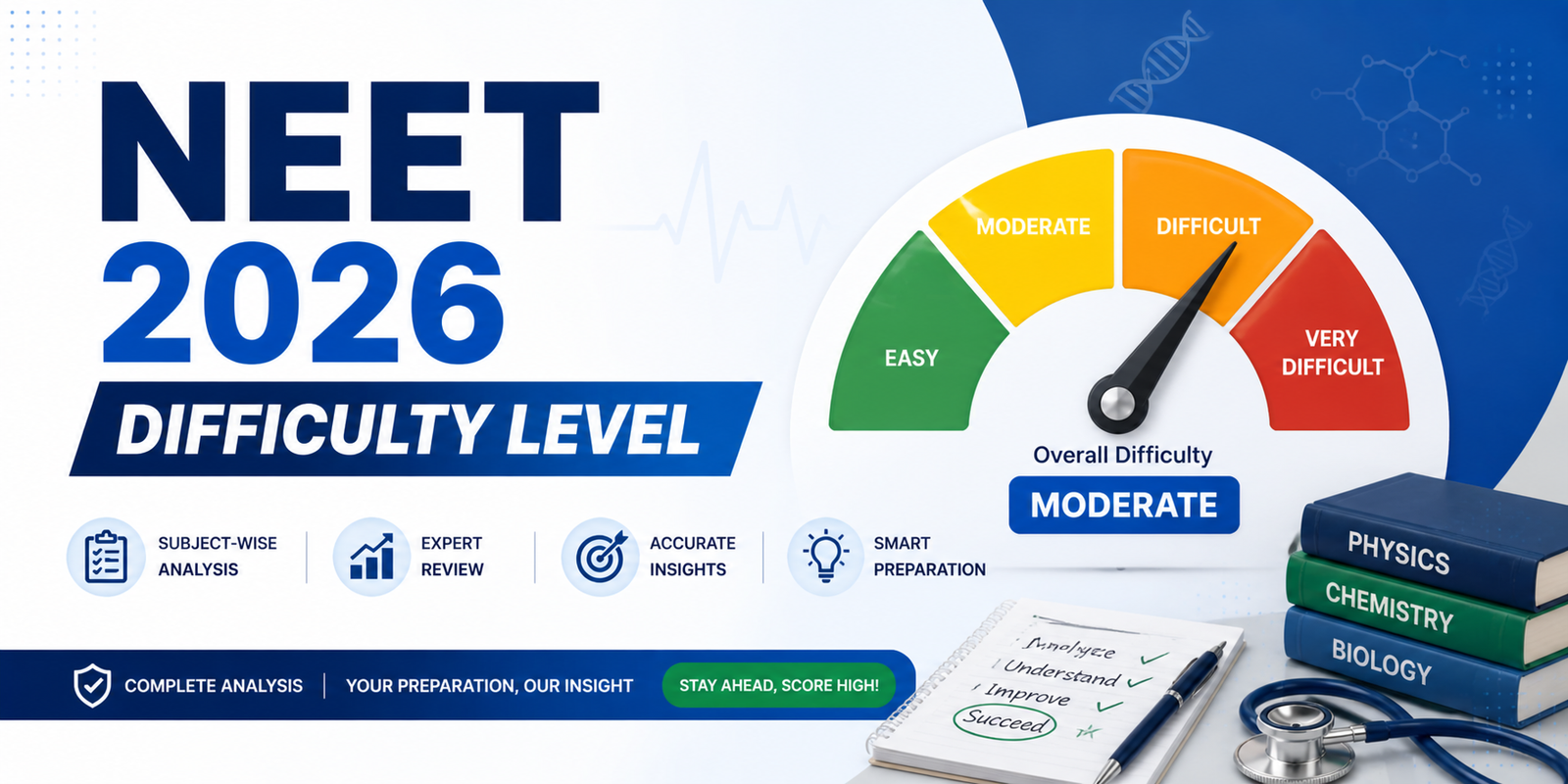
The NEET 2026 difficulty level is one of the most discussed topics among medical aspirants right after the exam. Conducted by the National Testing Agency, NEET is the single entrance exam for MBBS, BDS, and other medical courses in India. Every year, lakhs of students appear for this highly competitive exam, making the analysis of difficulty level extremely important.
Understanding the difficulty level helps students evaluate their performance, estimate their scores, and predict their chances of admission. It also plays a crucial role in determining the cutoff marks, as an easier paper generally leads to higher cutoffs, while a tougher paper results in lower cutoffs.
The NEET 2026 paper is expected to follow a similar pattern to previous years, but even slight changes in question style, conceptual depth, or time management can significantly impact overall difficulty. In this blog, we will provide a detailed subject-wise analysis, expected difficulty level, student reactions, and how it affects cutoff trends.
Overall NEET 2026 Difficulty Level (Expected)
Based on previous trends and expert analysis, the overall NEET 2026 paper is expected to be moderate to slightly difficult. The exam typically balances conceptual questions with NCERT-based direct questions.
- Easy Section: Direct NCERT questions, especially in Biology
- Moderate Section: Concept-based Physics and Chemistry
- Difficult Section: Numerical-based Physics and tricky Chemistry questions
The difficulty level depends on how the questions are framed rather than the syllabus itself. Even a familiar topic can become challenging if asked in a complex manner.
A moderate paper ensures a fair evaluation of students, but due to increasing competition, even moderate papers lead to high cutoff scores.
Subject-wise Difficulty Level Analysis
1. Biology (Botany + Zoology)
Biology is expected to be the easiest section in NEET 2026, as it is largely based on NCERT textbooks. Most questions are direct, factual, or concept-based.
- Difficulty Level: Easy to Moderate
- Weightage: 50% of the paper
- Key Topics: Genetics, Ecology, Human Physiology
Students who thoroughly prepare NCERT can score very high in Biology. However, tricky statements and assertion-reason questions may increase difficulty slightly.
2. Physics
Physics is generally considered the toughest section in NEET.
- Difficulty Level: Moderate to Difficult
- Key Topics: Mechanics, Electricity, Modern Physics
The section includes numerical problems that require strong conceptual understanding and time management. Lengthy calculations can make the paper time-consuming, increasing overall difficulty.
Students often struggle with Physics due to complex formulas and problem-solving requirements.
3. Chemistry
Chemistry difficulty varies across its three sections:
- Physical Chemistry: Moderate (numerical-based)
- Organic Chemistry: Easy to Moderate (reaction-based)
- Inorganic Chemistry: Easy (NCERT-based)
Overall Difficulty: Moderate
Chemistry acts as a scoring subject for many students, especially when questions are directly from NCERT.
Comparison with Previous Years
The NEET 2026 paper is expected to follow trends similar to recent years:
- NEET 2025: Moderate difficulty
- NEET 2024: Moderate to difficult (Physics tough)
- NEET 2023: Moderate
This indicates a consistent pattern where the paper is balanced but slightly challenging due to Physics.
Student Reactions (Expected Trends)
After the exam, student reactions usually vary based on preparation level.
- High scorers: Found the paper moderate and manageable
- Average students: Found Physics difficult
- Low scorers: Found the paper lengthy and time-consuming
Many students often report that Biology is easy, while Physics determines the overall difficulty level.
Impact on NEET 2026 Cutoff
The difficulty level directly affects the cutoff:
- Easy Paper → High Cutoff
- Moderate Paper → Balanced Cutoff
- Difficult Paper → Lower Cutoff
Expected cutoff for 2026:
- General Category: 620–650 marks (for government colleges)
- Reserved Categories: Slightly lower
If the paper is tougher than expected, cutoff may decrease.
Time Management & Difficulty
Time management plays a major role in handling difficulty.
- Biology: Less time required
- Chemistry: Moderate time
- Physics: Maximum time required
Students who manage time efficiently can attempt more questions accurately, reducing the impact of difficult sections.
Common Challenges Faced by Students
- Lengthy Physics numericals
- Tricky Biology statements
- Confusing Chemistry reactions
- Time pressure during exam
These factors contribute to perceived difficulty, even if the paper is moderate overall.
Expert Analysis
Experts generally analyze difficulty based on:
- Question pattern
- Conceptual depth
- NCERT coverage
- Time required per question
A paper with more conceptual and application-based questions is considered difficult.
How to Handle NEET Difficulty
Students can manage difficulty by:
- Strengthening concepts
- Practicing mock tests
- Focusing on NCERT
- Improving time management
Consistent preparation reduces exam pressure and improves performance.
Role of Counseling After Exam
After analyzing difficulty and estimating score, students should prepare for counseling. Expert guidance from Doctors Guardian helps students:
- Analyze performance
- Predict rank
- Choose colleges
- Secure admission
This ensures a smooth transition from exam to admission.
FAQs
Conclusion
The NEET 2026 difficulty level is expected to be moderate, with Biology being easier and Physics slightly challenging. Understanding the difficulty helps students evaluate their performance and predict cutoff trends.
While difficulty plays an important role, success ultimately depends on preparation, accuracy, and time management. Students should focus on analyzing their performance and planning the next steps strategically.
With the right approach, even a difficult paper can lead to success in NEET.