
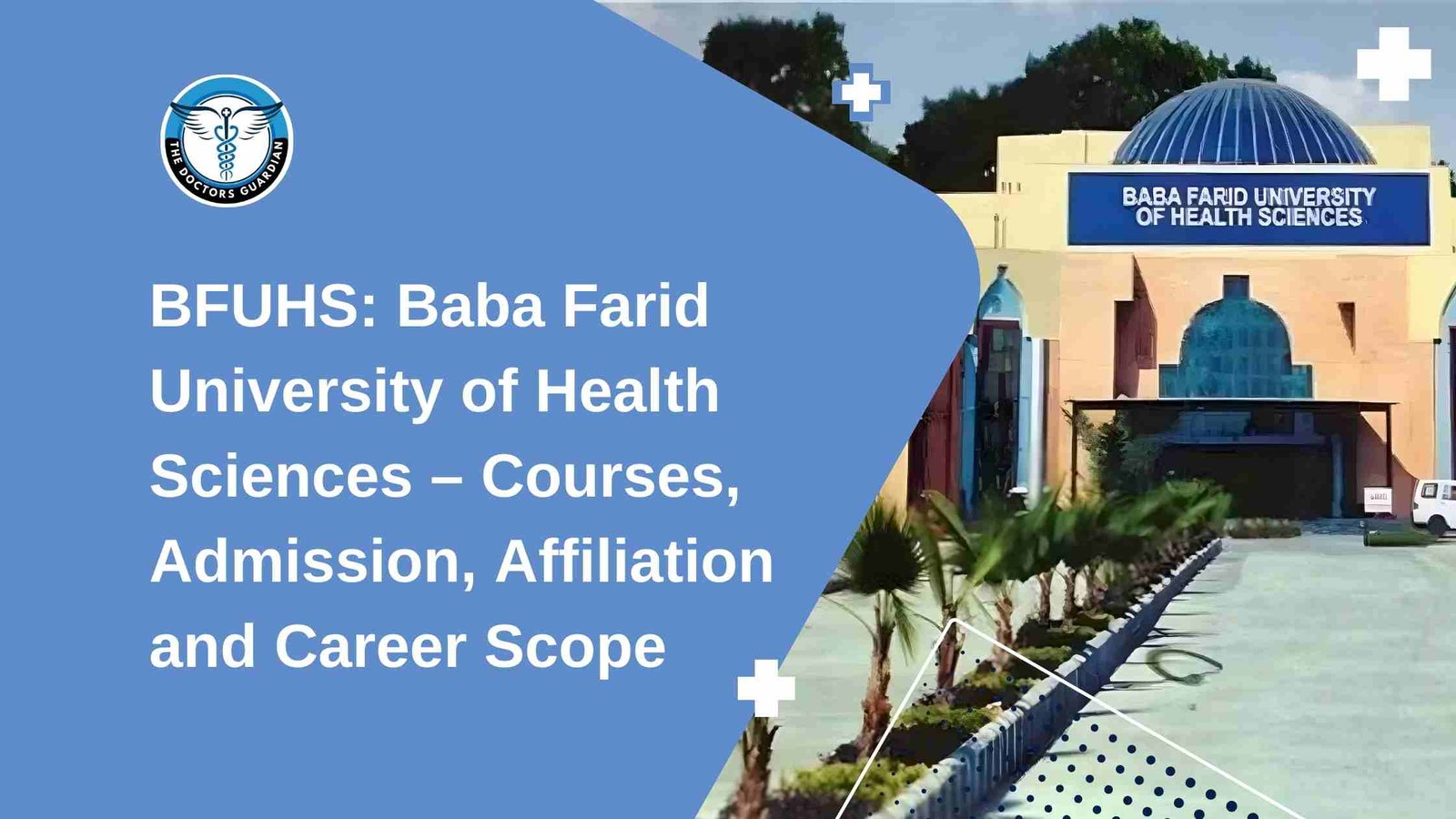
Baba Farid University of Health Sciences, commonly known as BFUHS, is one of the most important medical universities in northern India. It plays a major role in regulating and improving medical, dental, nursing, and paramedical education in Punjab. Students who wish to pursue careers in healthcare often come across BFUHS when applying for MBBS, BDS, BSc Nursing, and postgraduate medical courses. The university is known for maintaining academic standards, conducting transparent examinations, and overseeing medical education in the state.
This blog explains what BFUHS is, its history, role, courses, admission process, affiliated colleges, and future scope.
What is BFUHS?
BFUHS stands for Baba Farid University of Health Sciences. It is a state government medical university located in Faridkot, Punjab. The university was established to coordinate, supervise, and regulate medical and health science education in Punjab. It is named after Baba Farid, a respected spiritual figure known for his teachings and contributions to society.
BFUHS acts as the central authority for conducting examinations and granting degrees in health science courses offered by government and private medical colleges affiliated with it.
History and Establishment of BFUHS
Baba Farid University of Health Sciences was established in the year 1998 by an act of the Punjab Legislative Assembly. Before its formation, medical colleges in Punjab were affiliated with general universities. The creation of BFUHS helped bring all medical and health science education under one specialized university.
The main objective behind its establishment was to improve the quality of healthcare education and ensure uniform academic standards across all medical institutions in the state.
Role of BFUHS in Medical Education
BFUHS performs several important academic and administrative functions:
- Affiliates medical, dental, nursing, and paramedical colleges in Punjab
- Conducts professional examinations
- Prescribes syllabus and academic regulations
- Grants degrees and diplomas
- Monitors teaching and training standards
- Coordinates with national regulatory bodies
The university ensures that medical students receive structured education and practical training according to national norms.
Courses Offered Under BFUHS
BFUHS governs a wide range of undergraduate, postgraduate, and diploma programs in health sciences.
Undergraduate Courses
Some of the main undergraduate courses include:
- MBBS
- BDS
- BSc Nursing
- BSc Medical Laboratory Technology
- BSc Radiology and Imaging
- BSc Anesthesia Technology
- Bachelor of Physiotherapy
- Bachelor of Occupational Therapy
These programs focus on building a strong foundation in medical sciences and clinical skills.
Postgraduate Courses
BFUHS also supervises postgraduate medical education, including:
- MD (various medical specialties)
- MS (surgical specialties)
- MDS
- MSc Nursing
- MSc Medical Laboratory Technology
- Master of Physiotherapy
Postgraduate courses help doctors and healthcare professionals gain advanced knowledge and specialization.
Diploma and Paramedical Courses
BFUHS regulates several diploma and certificate programs such as:
- Diploma in Medical Laboratory Technology
- Diploma in Radiology
- Diploma in Operation Theatre Technology
- Diploma in Nursing
- Emergency Medical Technician courses
These programs are essential for producing skilled support staff in hospitals and clinics.
Admission Process Under BFUHS
Admission to courses under BFUHS is based on national or state-level entrance examinations, depending on the program.
MBBS and BDS Admission
Admission to MBBS and BDS is done through NEET-UG. After qualifying NEET, students participate in state counseling conducted by BFUHS for Punjab quota seats.
Postgraduate Medical Admission
Admission to MD and MS courses is done through NEET-PG followed by state counseling conducted by BFUHS.
Nursing and Paramedical Courses
For nursing and paramedical courses, BFUHS conducts its own entrance tests or follows merit-based admission depending on course rules.
Affiliated Colleges Under BFUHS
BFUHS has a large network of affiliated colleges across Punjab, including:
- Government medical colleges
- Private medical colleges
- Dental colleges
- Nursing colleges
- Paramedical institutes
All affiliated institutions must follow the academic rules and examination system of BFUHS.
Examination System of BFUHS
The examination system of BFUHS is known for being structured and transparent. It includes:
- Annual or semester examinations
- Internal assessments
- Practical and viva examinations
- Central evaluation
The university maintains strict examination discipline and timely result declaration.
Importance of BFUHS in Punjab Healthcare
BFUHS plays a vital role in strengthening healthcare services in Punjab by producing trained doctors, nurses, and paramedical staff. Its graduates serve in government hospitals, private clinics, medical colleges, and research institutions.
By standardizing education, BFUHS ensures that medical professionals in the state meet national quality benchmarks.
Recognition and Approval
BFUHS is recognized by:
- Government of Punjab
- University Grants Commission
- National medical regulatory authorities
Its degrees are valid throughout India and accepted for employment and higher education.
BFUHS and Medical Research
The university encourages medical research through postgraduate dissertations, clinical studies, and institutional research projects. Research work under BFUHS helps improve disease management, public health strategies, and treatment methods in Punjab and nearby regions.
Career Opportunities After BFUHS Courses
Students who graduate from BFUHS-affiliated colleges can pursue various career paths:
- Government medical officer
- Private practitioner
- Hospital consultant
- Academic faculty
- Researcher
- Healthcare administrator
- Public health professional
Nursing and paramedical graduates also find opportunities in hospitals, laboratories, and emergency services.
BFUHS and Digital Services
BFUHS has introduced digital systems for:
- Online application forms
- Online counseling
- Result declaration
- Admit cards
- Student registration
These services improve transparency and reduce administrative delays.
Challenges Faced by BFUHS
Like any large university, BFUHS faces challenges such as:
- Managing large student populations
- Maintaining uniform standards
- Updating curriculum with medical advancements
- Infrastructure improvement
However, continuous reforms and policy updates help overcome these challenges.
Future Scope of BFUHS
The future of BFUHS is promising due to increasing demand for healthcare professionals in India. Expansion of medical colleges and introduction of new health science courses will further strengthen the university’s role.
BFUHS is expected to focus more on:
- Skill-based training
- Research-oriented education
- Technology integration
- Interdisciplinary healthcare learning
Common Misconceptions About BFUHS
Some students think BFUHS is only for MBBS, but it governs a wide range of health science programs. Another misconception is that BFUHS only manages government colleges, whereas it also affiliates many private institutions.
BFUHS is not a single medical college but a university that controls and supervises multiple colleges.
MBBS Seat Distribution in Punjab
The MBBS seats under BFUHS counseling are generally distributed as follows:
| Quota | Approximate Percentage |
|---|---|
| Government Quota | 50% |
| Management Quota | 35% |
| NRI Quota | 15% |
The exact seat matrix may vary slightly depending on the college and government notifications issued during the admission session.
BFUHS MBBS Fee Structure 2025-26 (Private Medical Colleges)
According to the Punjab Government notification implemented through BFUHS for private medical colleges:
Government Quota Seats
| Year | Fee |
|---|---|
| First Year | ₹4,47,000 |
| Second Year | ₹4,90,000 |
| Third Year | ₹5,36,000 |
| Fourth Year | ₹5,81,000 |
| Final Year (6 Months) | ₹3,13,000 |
Management Quota Seats
| Year | Fee |
|---|---|
| First Year | ₹11,49,000 |
| Second Year | ₹12,64,000 |
| Third Year | ₹13,80,000 |
| Fourth Year | ₹14,94,000 |
| Final Year (6 Months) | ₹8,05,000 |
These fees apply to most private medical colleges participating in Punjab counseling. Additional hostel, security, examination, and miscellaneous charges may apply separately.
Government Medical College Fees in Punjab
Government medical colleges affiliated with BFUHS have significantly lower tuition fees compared to private institutions.
Typical annual tuition fee ranges between:
- ₹1.5 lakh to ₹2 lakh per year
Government colleges remain the most affordable option for Punjab MBBS aspirants.
Management Quota Admission Through BFUHS
Management quota seats are available in private medical colleges affiliated with BFUHS.
Eligibility
- Qualified NEET UG
- Registered for Punjab State Counseling
- Participation in BFUHS counseling
Important points:
- Direct admission without counseling is not permitted.
- All management quota admissions are conducted through centralized counseling.
NRI Quota Admission
Punjab medical colleges reserve seats under the NRI quota.
Eligibility for NRI Quota
Generally includes:
- NRIs
- Children of NRIs
- Wards sponsored by NRIs
- OCI/PIO candidates (subject to applicable rules)
Candidates must submit supporting NRI documents during counseling verification. The fee structure under NRI quota is substantially higher than government and management quota seats.
BFUHS stands for Baba Farid University of Health Sciences. It is a state government medical university located in Faridkot, Punjab. The university regulates medical, dental, nursing, and paramedical education in the state. It affiliates government and private colleges, conducts professional examinations, and awards degrees. BFUHS plays an important role in maintaining uniform academic standards and improving healthcare education across Punjab.
Baba Farid University of Health Sciences was established in 1998 by an act of the Punjab Legislative Assembly. The university was created to bring all health science education under one specialized institution. Before its formation, medical colleges in Punjab were affiliated with general universities. BFUHS helped improve coordination, quality control, and academic structure for medical and allied health courses in the state.
BFUHS regulates a wide range of courses including MBBS, BDS, BSc Nursing, BSc Paramedical courses, MD, MS, MDS, MSc Nursing, and diploma programs. It also oversees physiotherapy, laboratory technology, radiology, and operation theatre technology courses. The university ensures that all affiliated colleges follow a common syllabus and examination pattern for these health science programs.
Admission under BFUHS is mainly done through national-level entrance examinations such as NEET-UG for MBBS and BDS and NEET-PG for MD and MS courses. After qualifying the entrance exam, students participate in state-level counseling conducted by BFUHS for Punjab quota seats. Nursing and paramedical courses may have entrance tests or merit-based admissions as per university guidelines.
BFUHS has a large network of affiliated institutions across Punjab, including government and private medical colleges, dental colleges, nursing colleges, and paramedical institutes. These colleges must follow BFUHS academic rules, syllabus, and examination system. Affiliation ensures quality control and standardization of education across all healthcare disciplines under the university’s supervision.
BFUHS conducts professional examinations at regular intervals as per academic schedules. These include theory papers, practical exams, and viva voce. The university follows a centralized evaluation system to ensure fairness and uniformity. Results are published online, and students receive officially issued mark sheets and degrees. Strict examination discipline helps maintain academic credibility.
Yes, BFUHS is recognized by the Government of Punjab and national regulatory authorities. Its degrees are valid across India for employment and higher education. Graduates from BFUHS-affiliated colleges are eligible to apply for government jobs, postgraduate studies, and professional practice. The university follows national education standards in healthcare training.
Students graduating from BFUHS-affiliated colleges can work as doctors, dentists, nurses, physiotherapists, or paramedical professionals. Career options include government hospitals, private hospitals, medical colleges, research institutions, and healthcare administration. Many graduates also pursue higher studies or specialization to improve professional growth and earning potential.
BFUHS encourages medical research through postgraduate dissertations, clinical studies, and institutional research programs. Research work helps improve healthcare practices and disease management. Students and faculty participate in conferences and workshops to enhance academic knowledge. Research activities also contribute to public health improvement and medical innovation within Punjab and surrounding regions.
The future scope of BFUHS is strong due to rising demand for healthcare professionals. The university is expected to expand medical education through new colleges and courses. Focus areas include skill-based learning, digital education systems, and research-oriented programs. BFUHS will continue to play a central role in developing trained medical manpower for Punjab and India.
Conclusion
Baba Farid University of Health Sciences, commonly known as BFUHS, is a key institution for medical and healthcare education in Punjab. It regulates undergraduate, postgraduate, nursing, dental, and paramedical courses with a focus on academic discipline and clinical excellence.
With strong examination systems, wide college affiliation, and growing recognition, BFUHS continues to shape the future of healthcare education in the state. Students seeking careers in medicine and allied health sciences can consider BFUHS as a reliable and respected educational authority.